





Grade 7 math tests can feel difficult because students are no longer solving one isolated skill at a time. They may need to read a word problem, identify a proportional relationship, choose the correct operation, manage negative numbers, and explain an answer all in the same question.
The good news is that many Grade 7 math mistakes are predictable and fixable. This guide shows the most common errors, why they happen, and how parents can help students turn each mistake into a focused practice plan.
Why Grade 7 Mistakes Happen
Grade 7 math asks students to connect ideas across topics. A proportional relationship may appear in a table, graph, equation, or word problem. A percent problem may include tax, tip, discount, markup, or percent change. A geometry question may require students to know whether the problem asks for circumference, area, surface area, or volume.
Many wrong answers are not caused by not knowing any math. They come from rushing, choosing the wrong model, ignoring units, mixing up signs, or forgetting to check whether the answer makes sense. That means students can improve quickly when review is organized.
Common Grade 7 Math Test Mistakes
Proportional Relationships and Unit Rates
Students often compare the wrong quantities or treat every relationship as proportional. Fix this by labeling both columns, checking whether the ratio stays constant, and writing the unit rate in words.
Percent Problems
Students may calculate from the final amount instead of the original amount. Fix this by asking, "What is the whole?" before working with discounts, markups, tax, tips, and percent change.
Rational-Number Sign Errors
Integer, fraction, and decimal problems can go wrong when students lose a negative sign. Fix this by estimating first and writing a sign check before the final answer.
Equations and Inequalities
Students sometimes guess, skip inverse operations, or forget what an inequality means in a real situation. Fix this by solving step by step and checking the solution in the original problem.
Geometry Formula Mix-Ups
Students may use circumference when they need area, radius when they need diameter, or square units when they need cubic units. Fix this by naming the measurement before choosing the formula.
Statistics and Probability
Students may misread a graph scale, overlook outliers, or count outcomes incorrectly. Fix this by reading labels first and explaining what each number represents.
How to Fix Grade 7 Math Mistakes at Home
The best correction routine is short and specific. Do not reteach every topic after one practice test. Start with the top two mistake patterns and build confidence there first.
- Circle the exact step where the error happened.
- Name the mistake in student-friendly language.
- Review one worked example for that skill.
- Retry the missed question without looking at the answer.
- Practice one similar question to prove the skill transferred.
Parent tool
Grade 7 Error Log
An error log helps parents and students see repeated patterns. Use this after a quiz or practice test.
| Mistake Type | What It Looks Like | Fix | Next Practice |
|---|---|---|---|
| Proportional reasoning | The student uses addition when the relationship is multiplicative. | Find the unit rate or constant of proportionality. | Tables, graphs, equations, and ratio word problems. |
| Percent base error | The student calculates the percent from the wrong whole. | Identify original amount, change, and final amount first. | Discount, markup, tax, tip, and percent-change questions. |
| Sign mistake | The answer has the right size but the wrong sign. | Estimate and apply rational-number sign rules before calculating. | Integer, decimal, and fraction operation review. |
| Formula confusion | The student uses area, circumference, surface area, or volume incorrectly. | Ask what is being measured and write the unit type. | Circle, scale drawing, area, surface area, and volume problems. |
| Graph or data misread | The student ignores labels, scale, sample size, or probability total. | Read titles, axes, labels, and total outcomes first. | Statistics, probability, and data-display practice. |
4-Day Mistake-Fix Plan
Day 1: Sort mistakes
Group missed questions by topic. Choose the two biggest patterns instead of trying to fix everything.
Day 2: Review one skill
Study a worked example, explain the steps out loud, and retry the missed question.
Day 3: Practice similar problems
Use three to five targeted questions that match the same skill but are not identical.
Day 4: Take a short checkpoint
Use a short quiz or mixed review to see whether the correction stayed in place.
What to Practice Next
After a mistake review, students need targeted practice and then mixed practice. Targeted practice builds the skill. Mixed practice helps students recognize when to use the skill on a real test.
If your child needs a home routine, use our guide: Best Way to Use a Grade 7 Math Practice Test at Home.
Next step
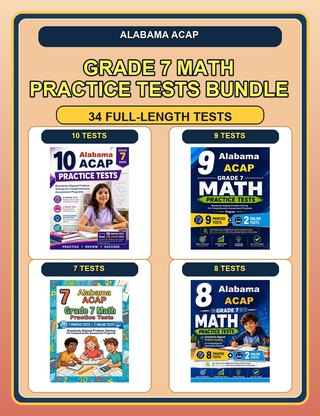
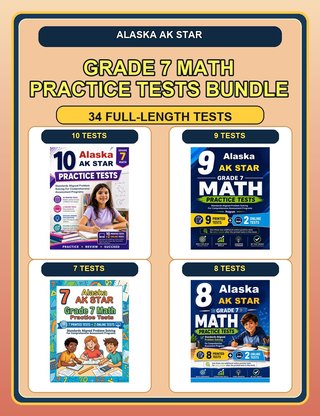
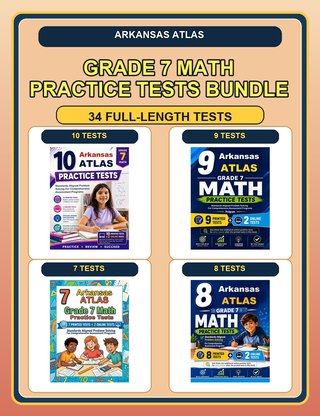
Find Grade 7 Math Practice Resources by State
Use state-aligned practice when your child is preparing for a state assessment. Start with one baseline test, review mistake patterns, and then use another test to measure improvement.
Summary
Common Grade 7 math test mistakes are fixable when students slow down, label information carefully, use the right strategy, and review errors by skill. The goal is not to take endless tests. The goal is to find weak patterns, practice them directly, and build steady confidence before the next assessment.
FAQ
What are the most common Grade 7 math test mistakes?
The most common mistakes are misreading proportional relationships, choosing the wrong percent base, losing negative signs, skipping equation checks, mixing up geometry formulas, misreading graphs, and rushing multi-step word problems.
How can parents help fix Grade 7 math mistakes?
Parents can help by using an error log, grouping missed questions by skill, reviewing one weak topic at a time, and having the student retry similar problems after each correction.
Why do Grade 7 students struggle with percent problems?
Percent problems often include discounts, markups, tax, tips, percent increase, and percent decrease. Students struggle when they do not identify the original whole before calculating.
Should students retake the same missed questions?
Yes, but not immediately as memorization. First review the strategy, then retry the missed question, and finally practice a similar question to show true understanding.
How often should a Grade 7 student review mistakes?
Short review sessions two or three times per week work well. A student should revisit missed skills a few days later so the correction becomes durable.
What is the fastest way to improve Grade 7 math test scores?
The fastest improvement usually comes from fixing high-frequency errors: proportional relationships, percents, rational-number operations, equations, inequalities, geometry formulas, and careful reading of word problems.