

SAT Prep
Build a study plan around your missed skills, not a long list of unrelated lessons. Start with current official practice, then use the math library and original reading/writing guides below to repair specific gaps.
Available here: Math, Reading and Writing

A clear route through your preparation
Use your missed skills to choose the next step, then return to practice.
- Find your starting point
Check current provider guidance and use suitable starting practice.
- Learn a skill
Study one weak area and follow a worked example.
- Practice with purpose
Try focused questions; use timed practice when appropriate.
- Review and repeat
Explain mistakes and decide what to work on next.
Follow the Math course
Use the ordered units, new topic lessons, and two independent timed Math practice forms. After each form, review the explained answers and follow the lesson links for missed skills.
Open the SAT Math courseChoose a focus
- Algebra and Advanced Math
- Problem-Solving and Data Analysis
- Geometry and Trigonometry
- Information and Ideas; Craft and Structure
- Standard English Conventions; Expression of Ideas
What to prepare for on the digital SAT
SAT Math has 44 questions across two 35-minute modules. Prepare for Algebra, Advanced Math, Problem-Solving and Data Analysis, and Geometry and Trigonometry. The study-skill guides below also introduce the four Reading and Writing domains.
Use fraction and number lessons to repair prerequisites, not as a substitute for algebra and problem solving. Our topic quizzes are independent skill practice, not official adaptive SAT tests.
College Board: current SAT Math overview · Official content domains
Start with a clear next step
- Check the official requirements. Confirm the version, subjects, calculator rules, accommodations, and registration with the provider or your school.
- Find your starting point. Try official practice first. Record which skills you missed, rather than studying every lesson in order.
- Review and apply. Learn one weak skill, do its available worksheet or quiz, then explain your mistakes before moving on.
Study skills with original practice
Each guide includes two worked examples, three practice questions, and explained answers. These are independent skill exercises, not full-length or adaptive exam simulations.
Math and quantitative reasoning
- Linear Models, Tables, and Predictions5 original examples and practice questions
- Samples, Surveys, and Statistical Claims5 original examples and practice questions
- Two-Way Tables and Conditional Probability5 original examples and practice questions
- Center, Spread, and Data Transformations5 original examples and practice questions
- Equation Parameters and Numbers of Solutions5 original examples and practice questions
- Quadratic Models and Equivalent Forms5 original examples and practice questions
- Function Transformations, Composition, and Piecewise Rules5 original examples and practice questions
- Circle Equations and Coordinate Geometry5 original examples and practice questions
- Data Models, Residuals, and Inference5 original examples and practice questions
- Exponential Functions and Growth Models5 original examples and practice questions
Reading, English, and writing
- Reading: Main Ideas and Textual Evidence5 original examples and practice questions
- Words in Context, Purpose, and Connections5 original examples and practice questions
- Sentence Boundaries and Standard English5 original examples and practice questions
- Transitions, Organization, and Rhetorical Synthesis5 original examples and practice questions
Find a math lesson
This is a supporting skill library, not a claim that every topic is on every exam. Match it to your provider's blueprint. Updated lessons include worked examples and explained practice answers.
122 lessons in the library
Number and fraction foundations 24 lessons
- Simplifying Fractions: Examples and PracticeUpdated lesson
- Adding and Subtracting Fractions: Examples and PracticeUpdated lesson
- Multiplying and Dividing Fractions: Examples and PracticeUpdated lesson
- Adding Mixed Numbers: Examples and PracticeUpdated lesson
- Subtracting Mixed Numbers: Examples and PracticeUpdated lesson
- Multiplying Mixed Numbers: Examples and PracticeUpdated lesson
- Dividing Mixed Numbers: Examples and PracticeUpdated lesson
- Comparing Decimals: Examples and PracticeUpdated lesson
- Rounding Decimals: Examples and PracticeUpdated lesson
- Adding and Subtracting Decimals: Examples and PracticeUpdated lesson
- Multiplying and Dividing Decimals: Examples and PracticeUpdated lesson
- Convert Fractions, Decimals, and Mixed NumbersUpdated lesson
- Factoring Numbers: Examples and PracticeUpdated lesson
- How to Find the Greatest Common Factor: Examples and PracticeUpdated lesson
- Least Common Multiple: Examples and PracticeUpdated lesson
- Divisibility Rules: Examples and PracticeUpdated lesson
- Adding and Subtracting Integers: Examples and PracticeUpdated lesson
- Multiplying and Dividing Integers: Examples and PracticeUpdated lesson
- Ordering Integers, Fractions, and Decimals: Examples and PracticeUpdated lesson
- Comparing and Ordering Integers: Examples and PracticeUpdated lesson
- Order of Operations: Examples and PracticeUpdated lesson
- Mixed Integer Computations: Examples and PracticeUpdated lesson
- Integers and Absolute Value: Examples and PracticeUpdated lesson
- Convert Percents, Fractions, and DecimalsUpdated lesson
Algebra: linear equations and systems 24 lessons
- Expressions and Variables: Examples and Explained PracticeUpdated lesson
- Simplifying Variable Expressions: Examples and Explained PracticeUpdated lesson
- Translating Phrases into Algebra: Examples and Explained PracticeUpdated lesson
- The Distributive Property: Examples and Explained PracticeUpdated lesson
- Evaluating One-Variable Expressions: Examples and Explained PracticeUpdated lesson
- Evaluating Two-Variable Expressions: Examples and Explained PracticeUpdated lesson
- Combining Like Terms: Examples and Explained PracticeUpdated lesson
- One-Step Equations: Examples and Explained PracticeUpdated lesson
- Two-Step Equations: Examples and Explained PracticeUpdated lesson
- Multi-Step Equations: Examples and Explained PracticeUpdated lesson
- Systems of Linear Equations: Examples and Explained PracticeUpdated lesson
- Systems of Equations Word Problems: Examples and Explained PracticeUpdated lesson
- Graphing One-Variable Inequalities: Examples and Explained PracticeUpdated lesson
- One-Step Inequalities: Examples and Explained PracticeUpdated lesson
- Two-Step Inequalities: Examples and Explained PracticeUpdated lesson
- Multi-Step Inequalities: Examples and Explained PracticeUpdated lesson
- Finding Slope: Examples and PracticeUpdated lesson
- Graphing Lines in Slope-Intercept Form: Examples and PracticeUpdated lesson
- Graphing Lines in Standard Form: Examples and PracticeUpdated lesson
- Writing Linear Equations: Examples and PracticeUpdated lesson
- Graphing Linear Inequalities: Examples and PracticeUpdated lesson
- Graphing Lines From Equations: Examples and PracticeUpdated lesson
- Adding and Subtracting Functions: Examples and PracticeUpdated lesson
- Multiplying and Dividing Functions: Examples and PracticeUpdated lesson
Advanced Math: nonlinear equations and expressions 30 lessons
- Expanding Polynomial Expressions: Examples and Explained PracticeUpdated lesson
- Quadratic Equations: Examples and Explained PracticeUpdated lesson
- Classifying Polynomials: Examples and Explained PracticeUpdated lesson
- Writing Polynomials in Standard Form: Examples and PracticeUpdated lesson
- Simplifying Polynomials: Examples and Explained PracticeUpdated lesson
- Adding and Subtracting Polynomials: Examples and Explained PracticeUpdated lesson
- Multiplying Monomials: Examples and Explained PracticeUpdated lesson
- Dividing Monomials: Examples and Explained PracticeUpdated lesson
- Multiplying a Polynomial by a Monomial: Examples and Explained PracticeUpdated lesson
- Multiplying Binomials: Examples and Explained PracticeUpdated lesson
- Factoring Trinomials: Examples and Explained PracticeUpdated lesson
- Operations with Polynomials: Examples and Explained PracticeUpdated lesson
- Multiplication Property of Exponents: Examples and Explained PracticeUpdated lesson
- Division Property of Exponents: Examples and Explained PracticeUpdated lesson
- Powers of Products and Quotients: Examples and Explained PracticeUpdated lesson
- Zero and Negative Exponents: Examples and Explained PracticeUpdated lesson
- Negative Exponents and Negative Bases: Examples and Explained PracticeUpdated lesson
- Scientific Notation: Examples and Explained PracticeUpdated lesson
- Square Roots: Examples and Explained PracticeUpdated lesson
- Graphing Quadratic Functions: Examples and PracticeUpdated lesson
- Solving Quadratic Equations: Examples and PracticeUpdated lesson
- Quadratic Formula and Discriminant: Examples and PracticeUpdated lesson
- Solving Quadratic Inequalities: Examples and PracticeUpdated lesson
- Function Notation: Examples and PracticeUpdated lesson
- Simplifying Radical Expressions: Examples and PracticeUpdated lesson
- Radical Fractions: Examples and PracticeUpdated lesson
- Multiplying Radical Expressions: Examples and PracticeUpdated lesson
- Adding and Subtracting Radicals: Examples and PracticeUpdated lesson
- Domain and Range of Radical Functions: Worked ExamplesUpdated lesson
- Solving Radical Equations: Examples and PracticeUpdated lesson
Problem-Solving and Data Analysis 16 lessons
- Writing Ratios: Examples and PracticeUpdated lesson
- Simplifying Ratios: Examples and PracticeUpdated lesson
- Creating a Proportion: Examples and PracticeUpdated lesson
- Similar Figures and Scale Factors: Examples and PracticeUpdated lesson
- Simple Interest: Examples and PracticeUpdated lesson
- Ratio and Rate Word Problems: Examples and PracticeUpdated lesson
- Proportional Ratios: Examples and PracticeUpdated lesson
- Percentage Calculations: Examples and PracticeUpdated lesson
- Solving Percent Problems: Examples and PracticeUpdated lesson
- Markup, Discount, and Sales Tax: Examples and PracticeUpdated lesson
- Percent Change: Examples and PracticeUpdated lesson
- Mean, Median, Mode, and Range: Methods, Examples, and PracticeUpdated lesson
- Box-and-Whisker Plots: Methods, Examples, and PracticeUpdated lesson
- Stem-and-Leaf Plots: Methods, Examples, and PracticeUpdated lesson
- Pie Charts and Circle Graphs: Methods, Examples, and PracticeUpdated lesson
- Probability Problems: Methods, Examples, and PracticeUpdated lesson
Geometry and Trigonometry 23 lessons
- Finding Midpoints: Examples and PracticeUpdated lesson
- Distance Between Two Points: Examples and PracticeUpdated lesson
- The Pythagorean Theorem: Methods, Examples, and PracticeUpdated lesson
- Triangle Angles and Area: Methods, Examples, and PracticeUpdated lesson
- Perimeter of Polygons: Methods, Examples, and PracticeUpdated lesson
- Circle Area and Circumference: Methods, Examples, and PracticeUpdated lesson
- Square, Rectangle, and Parallelogram Area: Methods, Examples, and PracticeUpdated lesson
- Area of Trapezoids: Methods, Examples, and PracticeUpdated lesson
- Angle Relationships: Methods, Examples, and PracticeUpdated lesson
- Volume of Cubes: Methods, Examples, and PracticeUpdated lesson
- Volume of Rectangular Prisms: Methods, Examples, and PracticeUpdated lesson
- Cube Volume and Surface Area: Methods, Examples, and PracticeUpdated lesson
- Rectangular-Prism Surface Area: Methods, Examples, and PracticeUpdated lesson
- Volume of a Cylinder: Methods, Examples, and PracticeUpdated lesson
- Surface Area of a Cylinder: Methods, Examples, and PracticeUpdated lesson
- Pyramids and Cones: Volume and Surface Area: Methods, Examples, and PracticeUpdated lesson
- Angles in Standard Position: Examples and PracticeUpdated lesson
- Coterminal and Reference Angles: Degrees, Radians, ExamplesUpdated lesson
- Converting Degrees to Radians: Examples and PracticeUpdated lesson
- Converting Radians to Degrees: Examples and PracticeUpdated lesson
- Evaluating Trigonometric Functions: Examples and PracticeUpdated lesson
- Missing Sides and Angles in Right Triangles: Examples and PracticeUpdated lesson
- Arc Length and Sector Area: Examples and PracticeUpdated lesson
Additional math reference: sequences and series 5 lessons
Optional shared reference, not a separate SAT content domain. Prioritize the official SAT domains and your missed skills first.
- Arithmetic Sequences: Examples and PracticeUpdated lesson
- Geometric Sequences: Examples and PracticeUpdated lesson
- Arithmetic vs. Geometric Sequences: Differences and ExamplesUpdated lesson
- Finite Geometric Series: Examples and PracticeUpdated lesson
- Infinite Geometric Series: Examples and PracticeUpdated lesson
Practice resources
Get official full-length SAT practice
Use College Board's digital practice for the actual format. Testinar worksheets and topic quizzes help you practice individual skills.
Try four original math questions
This short skill check is not an official SAT test or a score prediction. Show your steps before opening the solutions.
- Solve \(3(2x-1)=15\).
- Find both solutions of \(x^2-5x+6=0\).
- A jacket costs $80 before a 15% price increase. What is its new price before tax?
- A right triangle has legs of 6 cm and 8 cm. Find its hypotenuse.
Solutions and what to review
- Distribute: \(6x-3=15\). Add 3: \(6x=18\). Divide by 6: \(x=3\). Substitute to check: \(3(6-1)=15\). Review linear equations if you missed this.
- Find factors of 6 with sum -5: -2 and -3. Factor as \((x-2)(x-3)=0\). Either factor can equal zero, so \(x=2\) or \(x=3\). Review quadratics and the zero-product property.
- Find the increase: \(0.15\times80=12\). Add it to the original price: \(80+12=92\). The new price is $92. Review percentages and identify the original base amount.
- Use \(c^2=6^2+8^2=36+64=100\). The length is positive, so \(c=\sqrt{100}=10\) cm. Review the Pythagorean theorem and distinguish a length from its square.
A practical four-week study sequence
Adjust this suggested plan to your starting point and test date. It is not a score guarantee.
Week 1: Diagnose
Take a starting practice test. Sort mistakes into concept gaps, reading errors, and time pressure. Review the two most important weak skills.
Week 2: Repair
Study one skill at a time. Work examples without looking at the solution, then check every step. Keep a short error log.
Week 3: Mix
Combine old and new topics. Include word problems, data, and calculator practice where your exam permits it. Revisit missed questions after a delay.
Week 4: Rehearse
Use current official practice under the correct conditions. Review repeated errors, confirm test-day arrangements, and leave time for rest.
Optional prep books
Browse the matching subjects and sample pages before choosing a printable e-book. Free lessons and official resource links remain available without a purchase.
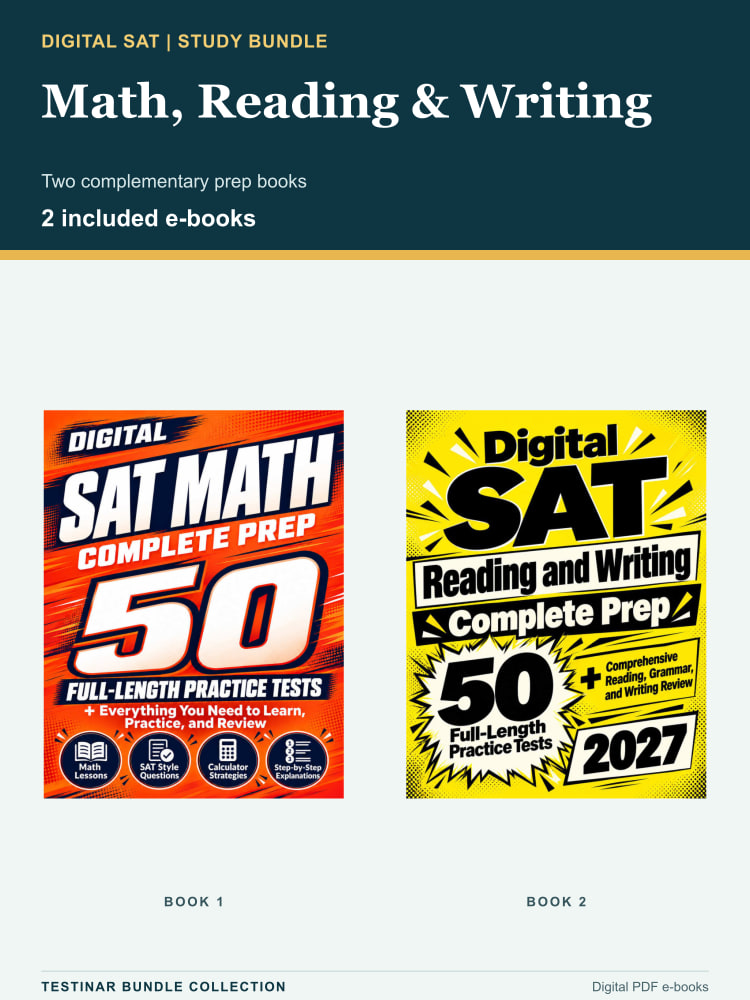 Digital SAT Math, Reading and Writing Study Set (2-Book PDF Bundle)$23.99 · View book and sample
 Digital SAT Math Complete Prep: 50 Full-Length Practice Tests + Everything You Need to Learn, Practice, and Review$19.99 · View book and sample
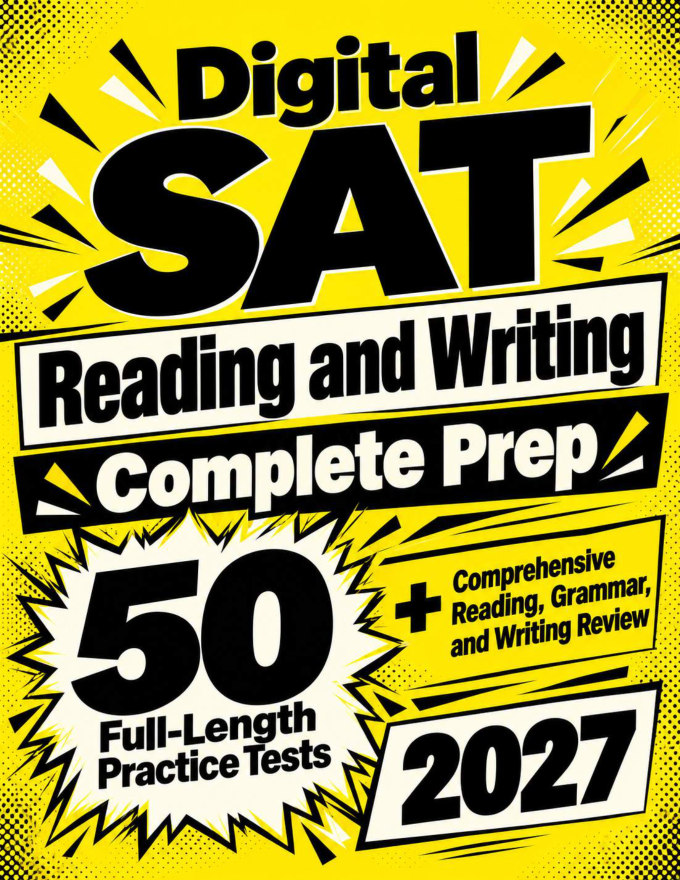 Digital SAT Reading and Writing Complete Prep$19.99 · View book and sample
Common questions
Are these official exam questions?
No. Testinar provides independent preparation. Use the linked exam provider for official practice, registration, and current policies.
Do I need to finish every lesson?
No. Start with your missed skills. Use basic lessons as prerequisites, then move to practice that matches your exam's content and format.
Will a skill quiz predict my exam score?
No. A short topic quiz checks a narrow skill. It is not a validated readiness measure or a conversion to an official exam score.
Exam-format references checked November 11, 2026. Provider requirements can change. Check the official source before registering.
