





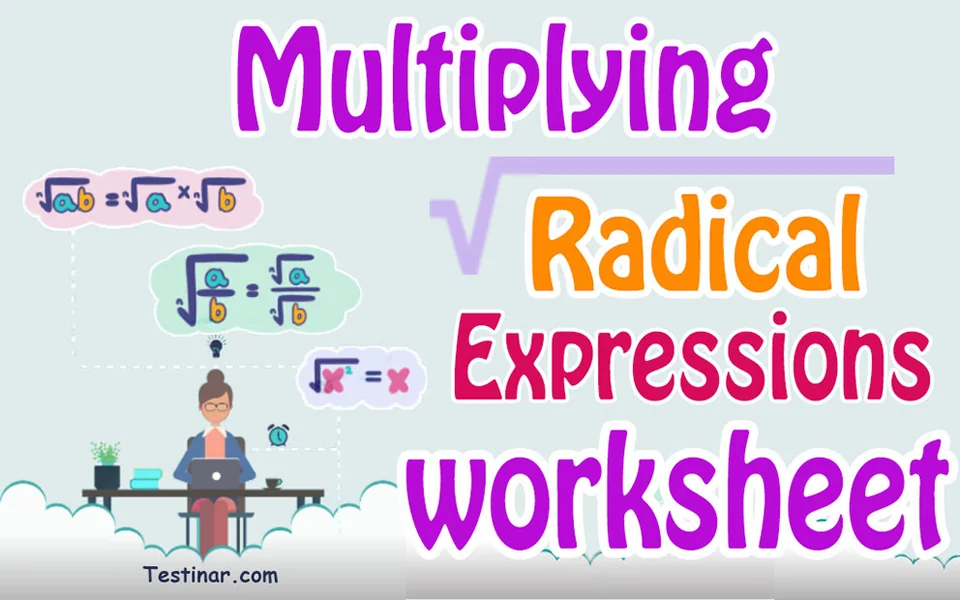
Multiply radical expressions by multiplying coefficients, multiplying compatible radicands, and then extracting perfect-square factors. Distribute across every term in a sum.
Free multiplying radical expressions practice: topic practice PDF, additional practice PDF. The original short practice below includes explained solutions.
Before using the worksheets
For \(a,b\ge0\), \(\sqrt a\sqrt b=\sqrt{ab}\). With binomials, multiply each term in the first factor by each term in the second. Conjugates are useful because \((u-v)(u+v)=u^2-v^2\). These real square-root product rules should not be applied blindly to negative radicands.
Worked examples for worksheet practice
Example 1
Multiply \(3\sqrt6\cdot2\sqrt{15}\).
Multiply coefficients: \(3(2)=6\). Multiply roots: \(\sqrt{6\cdot15}=\sqrt{90}=3\sqrt{10}\). Thus the product is \(6(3\sqrt{10})=18\sqrt{10}\).
Example 2
Expand \((2+\sqrt3)(1-\sqrt3)\).
Distribute all four products: \(2-2\sqrt3+\sqrt3-(\sqrt3)^2\). Since \((\sqrt3)^2=3\), combine to get \(2-3-\sqrt3=-1-\sqrt3\).
Try these before opening the solutions
- Multiply \(\sqrt8\cdot\sqrt{18}\).
- Expand \((\sqrt5+3)(\sqrt5-3)\).
- Expand \((1+\sqrt3)^2\).
Show step-by-step solutions
- The radicands are nonnegative, so combine: \(\sqrt{8\cdot18}=\sqrt{144}=12\).
- Use difference of squares: \((\sqrt5)^2-3^2=5-9=-4\). The mixed terms cancel.
- Write the square as \((1+\sqrt3)(1+\sqrt3)\). The four terms are \(1+\sqrt3+\sqrt3+3\), giving \(4+2\sqrt3\). The middle terms must not be omitted.
Common mistakes
The product of two radicals is not their sum. Squaring a binomial includes a middle term, and the real product rule needs nonnegative radicands.
Related skills
Multiplying Radical Expressions lesson; Simplifying Radical Expressions worksheets; Radical Fractions worksheets; Domain and Range of Radical Functions worksheets.

