





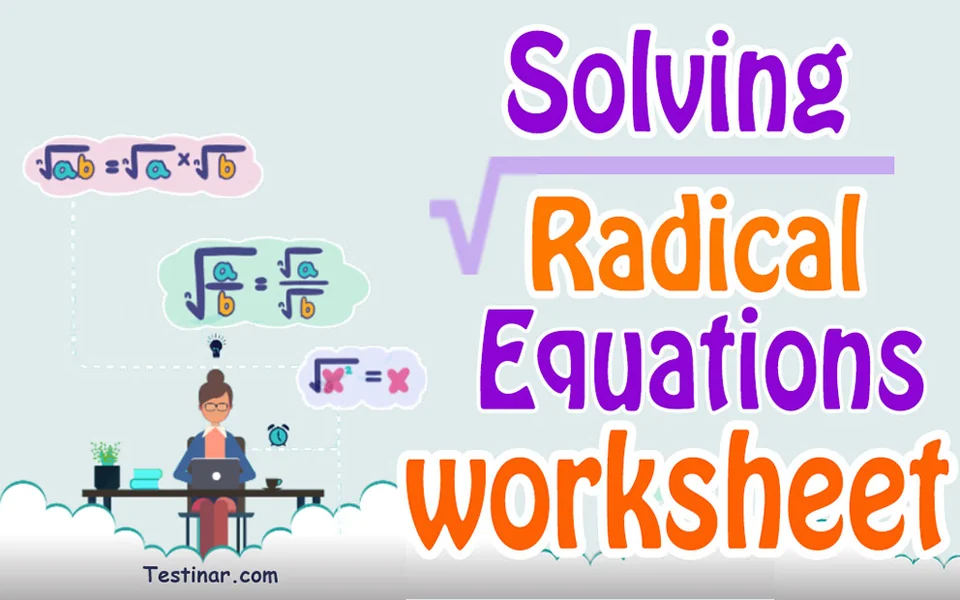
Solve a radical equation by isolating the radical, raising both sides to the appropriate power, solving the resulting equation, and checking every candidate in the original equation.
Download the radical-equations worksheet PDF or open another practice PDF. The examples and short exercise below explain the checking step.
Why checking the original equation matters
Over the real numbers, a square-root expression requires a nonnegative radicand and returns a nonnegative result. Squaring both sides can introduce an extraneous solution: a number satisfying the squared equation but not the original one. Treat the roots you find as candidates until checked.
- State restrictions on the radicand and the isolated square root's other side.
- Isolate one radical using addition, subtraction, or division.
- Square the entire expression on each side, including parentheses.
- Solve; if another radical remains, isolate it and repeat.
- Substitute every candidate into the original equation.
Worked examples
Example 1: \(\sqrt{2x+3}=5\). Square: \(2x+3=25\). Subtract 3 and divide by 2: \(x=11\). Check: \(\sqrt{2(11)+3}=\sqrt{25}=5\). The solution is 11.
Example 2: \(\sqrt{x+6}=x\). The right side must be nonnegative, so \(x\ge0\). Squaring gives \(x+6=x^2\), or \((x-3)(x+2)=0\). Candidates are 3 and -2. Check 3: \(\sqrt9=3\). Check -2: \(\sqrt4=2\ne-2\). Only 3 works.
Example 3: \(\sqrt{x+1}+1=\sqrt{x+4}\). First \(x\ge-1\). Squaring both sides gives \(x+2+2\sqrt{x+1}=x+4\). Subtract \(x+2\), divide by 2, and get \(\sqrt{x+1}=1\). Thus \(x=0\). Check: \(1+1=2\), so 0 is valid.
Avoid these common errors
Squaring \(x+3\) gives \(x^2+6x+9\), not \(x^2+9\). Also, \(\sqrt{9}=3\), not \(\pm3\); the equation \(x^2=9\) has two roots, but the principal square root has one value. A negative value on the isolated square root's other side can show that no real solution exists before you square.
Practice with step-by-step answers
- Solve \(\sqrt{3x-2}=4\).
- Solve \(\sqrt{x+2}=x\).
- Solve \(\sqrt{x+5}=-2\) over the real numbers.
Show solutions and checks
- Square to get \(3x-2=16\). Then \(3x=18\), so \(x=6\). Check: \(\sqrt{18-2}=4\).
- Require \(x\ge0\). Squaring gives \(x^2-x-2=0=(x-2)(x+1)\). Reject -1 because \(\sqrt1=1\ne-1\). Check 2: \(\sqrt4=2\). The solution is 2.
- A real square root cannot equal -2. There is no real solution. Squaring would create an invalid candidate.
For a deeper look at allowable inputs, see domain and range of radical functions.

