




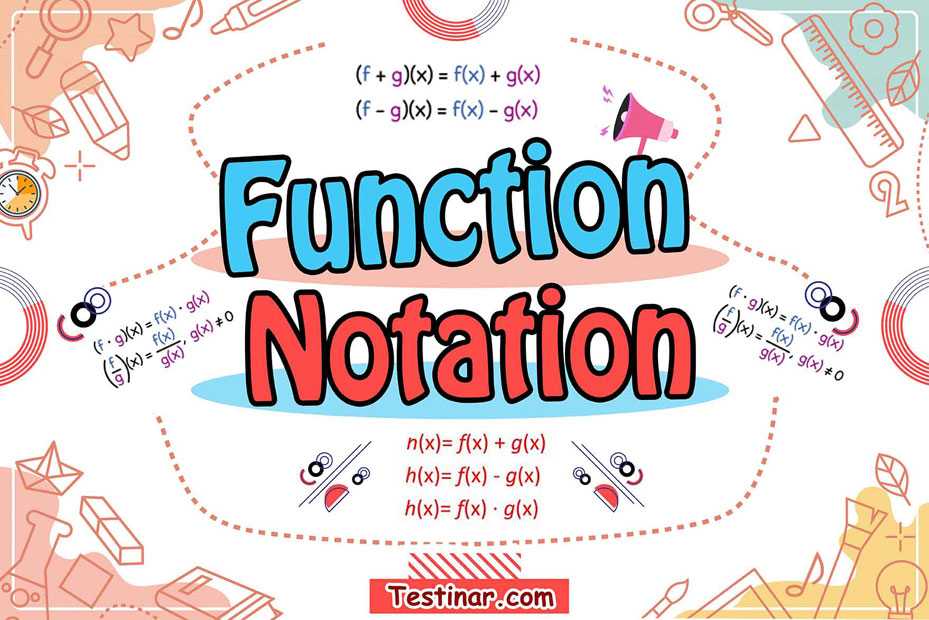
What is a Function Notation
Read,4 minutes
Function notation names the output for a given input. To evaluate, substitute the input for every x.
Domain
Check denominators and square roots before substituting.
.png)
Function Notation
Think of this lesson as more than a rule to memorize. Function Notation is about inputs, outputs, domains, and combining functions. A strong student does not rush to the first formula on the page; they pause, identify the structure of the problem, and then choose the tool that matches that structure. That pause is what prevents most mistakes.
A ratio compares quantities, and a proportion says two ratios are equal. Cross products help because \(\frac{a}{b}=\frac{c}{d}\) implies \(ad=bc\).
Here is the teacher way to approach the topic. First, read the problem slowly and underline the information that is actually given. Next, name the target: are you finding a value, simplifying an expression, comparing two quantities, solving for a variable, or interpreting a graph? Once the target is clear, the calculation becomes much less mysterious because every step has a job.
- Identify the input value or expression.
- Substitute carefully using parentheses.
- Simplify one operation at a time.
- Check domain restrictions such as zero denominators or even roots.
A helpful habit is to say what each number represents before using it. For example, if a number is a denominator, a radius, a slope, a common difference, or a coefficient, it should not be treated like an ordinary loose number. Its role tells you where it belongs in the formula. This is especially important on ACT-style questions because many wrong answer choices come from using the right numbers in the wrong places.
Another good habit is to keep the work organized vertically. Write one clean line for substitution, one line for simplifying, and one line for the final answer. If the problem has units, keep the units attached. If the problem has signs, exponents, or parentheses, copy them carefully from one line to the next. Most errors in this topic are not caused by a hard idea; they are caused by dropping a negative sign, combining unlike terms, using the wrong denominator, or skipping a check.
When you finish, ask a quick reasonableness question. Should the answer be positive or negative? Should it be larger or smaller than the original number? Does it fit the graph, table, shape, or equation? Can you plug it back into the original problem? This final check turns the lesson from a procedure into understanding.
On a test, the goal is not to write the longest solution. The goal is to write enough clear work that you can see the structure, avoid traps, and recover quickly if one line goes wrong. Practice the examples below with that mindset: identify the type of problem, choose the matching rule, show the substitution, simplify carefully, and check the answer before moving on.
Related Topics
How to Multiply and Divide Functions
How to Add and Subtract Functions
How to Solve Composition of Functions
How to Graph Quadratic Functions
Exercises for Function Notation
1) If \(f(x)=2x+2\), find \(f(-2)\).
2) If \(f(x)=3x+1\), find \(f(-1)\).
3) If \(f(x)=4x+0\), find \(f(0)\).
4) If \(f(x)=5x-1\), find \(f(1)\).
5) If \(f(x)=6x-2\), find \(f(2)\).
6) If \(g(x)=x^2-2x-4\), find \(g(-2)\).
7) If \(g(x)=2x^2-x-5\), find \(g(-1)\).
8) If \(g(x)=x^2+0x-6\), find \(g(0)\).
9) If \(g(x)=2x^2+x-7\), find \(g(1)\).
10) If \(g(x)=x^2+2x-8\), find \(g(2)\).
11) If \(h(x)=(3x+2)/(x-1)\), find \(h(5)\).
12) If \(h(x)=(4x+4)/(x-2)\), find \(h(6)\).
13) If \(h(x)=(5x+6)/(x-3)\), find \(h(7)\).
14) If \(h(x)=(6x+8)/(x-4)\), find \(h(8)\).
15) If \(r(x)=sqrt(x+6)\), find \(r(3)\).
16) If \(r(x)=sqrt(x+11)\), find \(r(5)\).
17) If \(r(x)=sqrt(x+17)\), find \(r(8)\).
18) If \(f(x)=4x+b\) and \(f(3)=17\), find \(b\).
19) If \(m(x)=ax-2\) and \(m(5)=18\), find \(a\).
20) If \(p(x)=x^2+k\) and \(p(-4)=21\), find \(k\).
\(\color{red}{Substitute -2 for x: f(-2)=2(-2)+2.}\)
\(\color{red}{f(-2)=-2.}\)
\(\color{red}{Substitute -1 for x: f(-1)=3(-1)+1.}\)
\(\color{red}{f(-1)=-2.}\)
\(\color{red}{Substitute 0 for x: f(0)=4(0)+0.}\)
\(\color{red}{f(0)=0.}\)
\(\color{red}{Substitute 1 for x: f(1)=5(1)-1.}\)
\(\color{red}{f(1)=4.}\)
\(\color{red}{Substitute 2 for x: f(2)=6(2)-2.}\)
\(\color{red}{f(2)=10.}\)
\(\color{red}{g(-2)=1(-2)^2-2(-2)-4.}\)
\(\color{red}{g(-2)=4.}\)
\(\color{red}{g(-1)=2(-1)^2-1(-1)-5.}\)
\(\color{red}{g(-1)=-2.}\)
\(\color{red}{g(0)=1(0)^2+0(0)-6.}\)
\(\color{red}{g(0)=-6.}\)
\(\color{red}{g(1)=2(1)^2+1(1)-7.}\)
\(\color{red}{g(1)=-4.}\)
\(\color{red}{g(2)=1(2)^2+2(2)-8.}\)
\(\color{red}{g(2)=0.}\)
\(\color{red}{The domain excludes x=1, and 5 is allowed.}\)
\(\color{red}{h(5)=(3(5)+2)/(5-1)=17/4.}\)
\(\color{red}{The domain excludes x=2, and 6 is allowed.}\)
\(\color{red}{h(6)=(4(6)+4)/(6-2)=28/4.}\)
\(\color{red}{The domain excludes x=3, and 7 is allowed.}\)
\(\color{red}{h(7)=(5(7)+6)/(7-3)=41/4.}\)
\(\color{red}{The domain excludes x=4, and 8 is allowed.}\)
\(\color{red}{h(8)=(6(8)+8)/(8-4)=56/4.}\)
\(\color{red}{Domain requires x+6>=0.}\)
\(\color{red}{r(3)=sqrt(9)=3.}\)
\(\color{red}{Domain requires x+11>=0.}\)
\(\color{red}{r(5)=sqrt(16)=4.}\)
\(\color{red}{Domain requires x+17>=0.}\)
\(\color{red}{r(8)=sqrt(25)=5.}\)
\(\color{red}{4(3)+b=17.}\)
\(\color{red}{b=5.}\)
\(\color{red}{5a-2=18.}\)
\(\color{red}{a=4.}\)
\(\color{red}{16+k=21.}\)
\(\color{red}{k=5.}\)
Function Notation Practice Quiz