





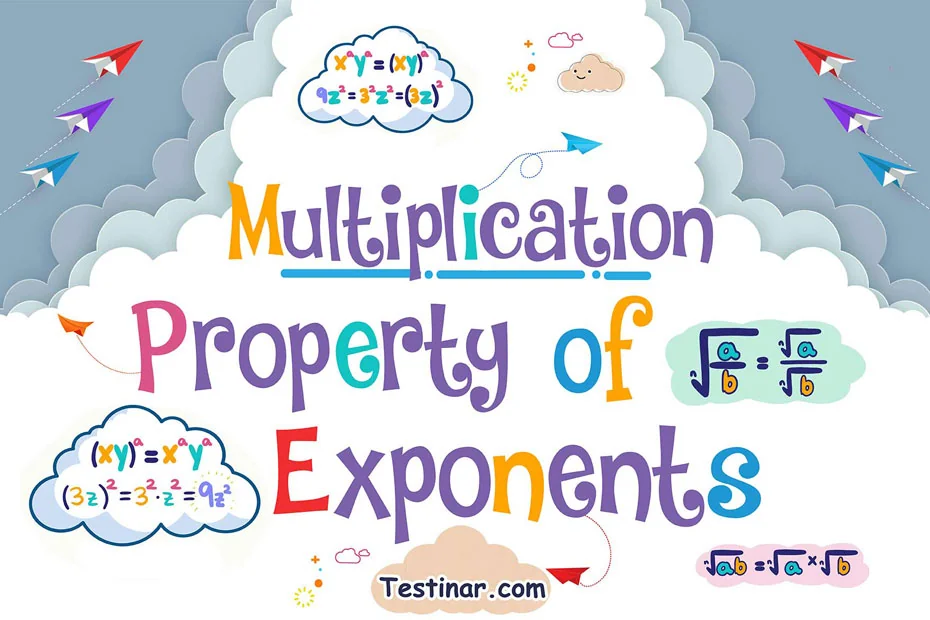
When multiplying powers with the same base, add their exponents and keep the base. A power raised to another power instead multiplies the exponents.
Printable multiplication property of exponents practice:
PDF set 1, PDF set 2, PDF set 3, Additional practice PDF.
Online practice: Topic quiz 1, Topic quiz 2.
The short practice below has step-by-step solutions. The printable files provide additional questions.
Method and restrictions
For nonnegative integer exponents, \(a^m a^n=a^{m+n}\). For integer exponents that include zero or negative values, use a nonzero base. Numeric coefficients are multiplied separately.
Worked example 1
Simplify \(x^3x^4\).
- The bases are both x, so add exponents: \(3+4=7\).
- Keep the base: \(x^3x^4=x^7\).
Worked example 2
Simplify \(2^3\cdot2^5\).
- Add the equal-base exponents: \(3+5=8\).
- Evaluate \(2^8=256\).
Common mistakes to avoid
The bases must match. You cannot turn 2 cubed times 3 squared into 6 to the fifth power, and the product rule does not apply to addition.
Short practice: try before opening the solutions
- Simplify \(a^2a^5a\).
- Simplify \(x^{-2}x^6\).
- Simplify \((y^3)^2\).
Show step-by-step solutions
Practice 1
Simplify \(a^2a^5a\).
- The final a has exponent 1.
- Add all three exponents: \(2+5+1=8\), so the answer is \(a^8\).
Practice 2
Simplify \(x^{-2}x^6\).
- Require x nonzero because the original expression has a negative exponent.
- Add exponents: \(-2+6=4\). The result is \(x^4\), still with x nonzero.
Practice 3
Simplify \((y^3)^2\).
- A power of a power multiplies exponents, rather than adding them.
- Multiply \(3\cdot2=6\), giving \(y^6\).
Related skills and resources
- Multiplication Property of Exponents worksheets
- How to Multiply Monomials
- How to Divide Exponents
- Division Property of Exponents worksheets
- Negative Exponents and Negative Bases worksheets
- Zero and Negative Exponents worksheets
- Square Roots worksheets
- Powers of Products and Quotients worksheets
- Scientific Notation worksheets
- How to solve negative exponents and negative bases
- How to Solve Zero and Negative Exponents
- What is the square root of a number
- How to Solve Powers of Products and Quotients
- How to convert a number to scientific notation

