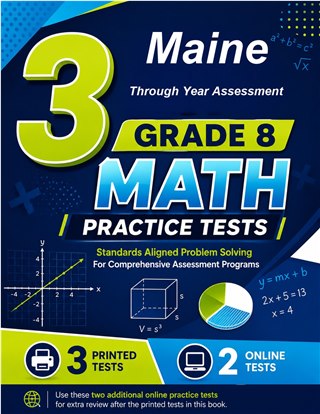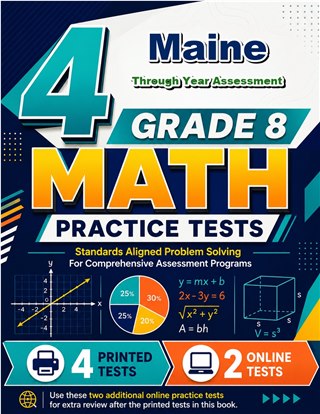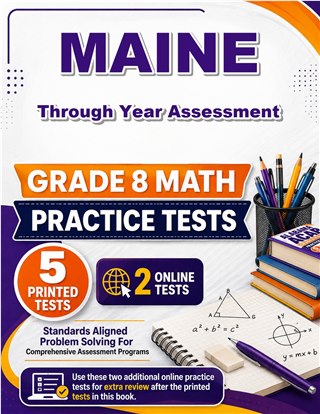





Grade 8 math standards can sound technical, but parents do not need to memorize every official phrase to help their child. The key is understanding what each skill means, how it appears in homework, and how it can show up on the Through Year Assessment math test.
This guide explains the Maine Grade 8 math standards in parent-friendly language, with practical signs to watch for, simple home practice ideas, and links to lessons, quizzes, and practice resources.
What Grade 8 Math Standards Mean
Math standards are learning goals. They describe what students should be able to understand, solve, explain, and apply by the end of the grade. For parents, standards are most helpful when they are translated into real skills.
For example, a function standard does not only mean identifying a rule. It can also mean reading a table, interpreting a graph, comparing two relationships, and explaining what the rate of change means in context.
How Maine Grade 8 Standards Connect to Through Year Assessment
The Through Year Assessment Grade 8 Math test is built around grade-level expectations. Students need to use standards in mixed situations, not only answer one type of problem at a time.
| At School | On Practice Tests | At Home |
|---|---|---|
| Students learn one skill at a time. | Students see real numbers, equations, functions, geometry, data, and word problems mixed together. | Parents can help by reviewing missed questions by skill. |
| Students use tables, graphs, equations, diagrams, and explanations. | Students must choose strategies and justify answers. | Parents can ask, "How do you know?" after each problem. |
| Students practice fluency and reasoning. | Students need accuracy, pacing, and stamina. | Parents can use short timed practice after untimed review. |
Parent-Friendly Grade 8 Math Standards Breakdown
These are the major skill areas most families should understand. Your child's school may organize or name them differently, but these are the big ideas that usually matter most for Grade 8 success.
Real Numbers, Square Roots, and Cube Roots
What it means: Students classify rational and irrational numbers, estimate square roots and cube roots, and place irrational values on a number line.
What parents should notice: Your child can explain why a number is rational or irrational and can estimate a square root without relying only on a calculator.
How to practice: Use number lines, perfect squares, perfect cubes, and real-world measurements. Ask students to explain which two whole numbers a square root falls between.
Exponents and Scientific Notation
What it means: Students use properties of integer exponents, simplify powers, and write very large or very small numbers in scientific notation.
What parents should notice: Your child can decide whether a power of ten makes a number larger or smaller and can compare numbers written in scientific notation.
How to practice: Use astronomy, cells, bacteria, distances, populations, and technology examples. Ask students to rewrite values in standard and scientific notation.
Linear Equations, Slope, and Systems
What it means: Students solve linear equations and inequalities, interpret slope as rate of change, write equations of lines, and solve systems of equations.
What parents should notice: Your child can connect a story, table, graph, and equation and can explain what slope or an intersection point means.
How to practice: Use phone plans, savings plans, taxi fares, sports rates, and comparison situations. Ask students to write an equation and explain each number.
Functions
What it means: Students identify functions, compare functions in different forms, and describe linear and nonlinear relationships from tables, graphs, equations, and words.
What parents should notice: Your child can tell whether each input has exactly one output and can compare two functions even when they are shown differently.
How to practice: Use tables, graphs, simple rules, subscription plans, and patterns. Ask students to identify inputs, outputs, starting values, and rates of change.
Transformations, Congruence, and Similarity
What it means: Students use translations, reflections, rotations, and dilations to reason about congruent and similar figures on and off the coordinate plane.
What parents should notice: Your child can describe how a figure moved or changed size and can track coordinate changes after a transformation.
How to practice: Use graph paper, logos, floor plans, and simple shapes. Ask students to describe the transformation before calculating coordinates.
Pythagorean Theorem, Distance, and Volume
What it means: Students use the Pythagorean theorem, find distances, and solve volume problems involving cylinders, cones, spheres, and composite figures.
What parents should notice: Your child can identify right triangles, choose the correct formula, label units, and explain why the answer is reasonable.
How to practice: Use ladders, maps, screens, boxes, cans, cones, and sports fields. Ask students to draw or identify the right triangle before solving.
Scatter Plots, Two-Way Tables, and Data
What it means: Students interpret scatter plots, fit lines to data, use linear models, read two-way tables, and compare data using measures such as mean absolute deviation.
What parents should notice: Your child can describe association, identify patterns, use a trend line carefully, and explain what a data table shows.
How to practice: Use sports stats, weather, study time, screen time, and survey data. Ask students to describe the trend and what can or cannot be concluded.
Multi-Step Word Problems and Mathematical Reasoning
What it means: Students combine skills, choose a strategy, check units, and explain whether an answer makes sense.
What parents should notice: Your child can underline the question, identify important information, write a plan, solve, and explain the final answer in context.
How to practice: Use one mixed word problem at a time. Ask for a plan before calculation and a reasonableness check after calculation.
How Parents Can Help at Home
The best home support is simple and consistent. A few focused questions, followed by careful discussion, can make a big difference.
- Ask your child to explain the strategy before checking the answer.
- Review missed questions by skill, not just by score.
- Mix old and new skills so students remember what they learned earlier.
- Use real-life math: distances, savings plans, sports data, maps, containers, graphs, technology numbers, and measurements.
- Use practice tests as checkpoints, not as the only study method.
Skill lessons
Helpful Grade 8 Math Lessons
Use these lessons when a standard feels unclear or when a practice quiz shows a weak skill area.
- Grade 8 Rational and Irrational Numbers
- Grade 8 Turning Repeating Decimals into Fractions
- Grade 8 Estimating Irrational Numbers
- Grade 8 Properties of Integer Exponents
- Grade 8 Square Roots and Cube Roots
- Grade 8 Understanding Scientific Notation
- Grade 8 Operations with Scientific Notation
- Grade 8 Graphing Proportional Relationships
- Grade 8 Slope as Rate of Change
- Grade 8 Slope and the Equations of a Line
- Grade 8 Solving Linear Equations in One Variable
- Grade 8 Solving Systems of Two Equations
- Grade 8 Solving Real Problems with Systems
- Grade 8 Solving Linear Inequalities
- Grade 8 What Is a Function?
- Grade 8 Reading Function Values
- Grade 8 Comparing Two Functions
- Grade 8 Linear vs. Nonlinear Functions
- Grade 8 Building Linear Functions
- Grade 8 Sketching and Describing Function Graphs
- Grade 8 Rotations, Reflections, and Translations
- Grade 8 Congruent Figures
- Grade 8 Transformations on the Coordinate Plane
- Grade 8 Similarity and Dilations
- Grade 8 Angles in Triangles and Parallel Lines
- Grade 8 The Pythagorean Theorem
- Grade 8 Finding Distance with the Pythagorean Theorem
- Grade 8 Volume of Cylinders, Cones, and Spheres
- Grade 8 Scatter Plots and Patterns in Data
- Grade 8 Fitting a Line to Data
- Grade 8 Using a Linear Model
Skill quizzes
Try Grade 8 Math Skill Quizzes
These quizzes open in a new tab and help students practice the skills that appear across Grade 8 math standards.
Standards practice
Try Maine Through Year Assessment Grade 8 Math Practice
After reviewing the standards, use this timed practice test to see which skills need more support.
Parent resources
Grade 8 Math Practice Resources for Maine
Practice resources
10 Maine Through Year Assessment Grade 8 Math Practice Tests
Review path
Start with standards, review lessons, try practice questions, then use timed practice as a checkpoint.
Next step
Turn Standards into Practice
After parents understand the standards, students need a clear review path: know what is on the test, try practice questions, and follow a weekly preparation plan.
What is on the test? Practice questions Preparation guideSummary
Maine Grade 8 math standards are easier to support when parents focus on the skill behind the wording. Students need strong real-number sense, exponent fluency, linear equation skills, function reasoning, geometry, data analysis, and multi-step reasoning. Short practice, clear explanations, and careful review of mistakes are the best path to steady progress.
FAQ
What are Maine Grade 8 math standards?
Maine Grade 8 Math Standards describe the Grade 8 math skills students are expected to understand and apply. These usually include real numbers, exponents, scientific notation, linear equations, slope, systems, functions, transformations, geometry, data, and word problems.
How do Grade 8 math standards connect to the Through Year Assessment test?
The Through Year Assessment math test checks whether students can use important Grade 8 skills in mixed problems, visual models, word problems, graphs, tables, diagrams, and reasoning questions.
What should parents review first?
Start with real numbers, exponent rules, scientific notation, linear equations, slope, functions, transformations, the Pythagorean theorem, volume, scatter plots, and two-way tables.
Should parents memorize standard codes?
No. Parents usually help more by understanding the skill behind each standard and practicing that skill with examples, questions, and mistake review.
How often should Grade 8 students practice math at home?
Short practice sessions three or four times per week are usually better than one long session. Use focused skill review, mixed practice questions, and careful correction of missed work.
Can standards or test rules change?
Yes. States can update standards, test platforms, tools, and rules. Use this page as a parent-friendly guide and confirm official details with your school or state education agency.