Grades 7-8Free, no account needed
Linear equation calculator
Solve ax + b = cx + d, with balance steps, exact answers and substitution checks.
Try your problem
ax + b = cx + d
Supported inputs and limits
Use coefficient boxes or paste a linear equation in x, such as 3(x + 2) = 18. Decimals, fractions and brackets are accepted. Products of variable terms and variables in denominators are not linear and are rejected.
Step by step
Understand the method
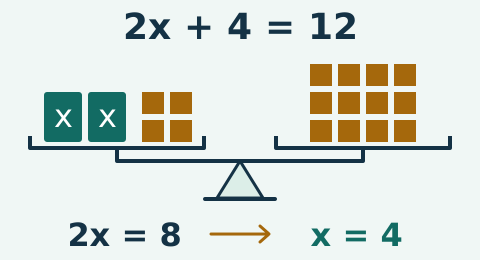
An equation states that two expressions are equal. Adding or subtracting the same quantity from both sides preserves that equality.
Collect variable terms on one side and constants on the other. Divide by the resulting nonzero coefficient. If it is zero, decide whether the remaining statement is always true or impossible.
Worked examples
Read the reasoning, or load an example into the calculator.
One solution
3x + 5 = x + 13 becomes 2x = 8, so x = 4.
No solution
2x + 1 = 2x + 4 becomes 0 = 3, which is impossible.
Every real value works
2x + 3 = 2x + 3 is true for every real x.
Try it without the calculator
Three questions for practice, not a graded school assessment. Your answers stay on this page and are not saved.
Original Testinar learning content. This local preview is awaiting final review before publication.