Grades 6-10Free, no account needed
Percent error calculator
Compare a measurement with a nonzero accepted value using exact percent error, signed difference and a number line.
Try your problem
Supported inputs and limits
Measured and accepted may be signed, from -1000000000 to 1000000000; accepted must be nonzero. Exact rational input up to 40 characters, nine finite decimal places and reduced denominator <=1000000000; no scientific notation or expressions. Percent error and signed difference are exact fractions; optional decimal percent is approximate to 10 significant digits. Matching length/measurement units are assumed. Paste percentError(98,100), at most 200 characters.
Step by step
Understand the method
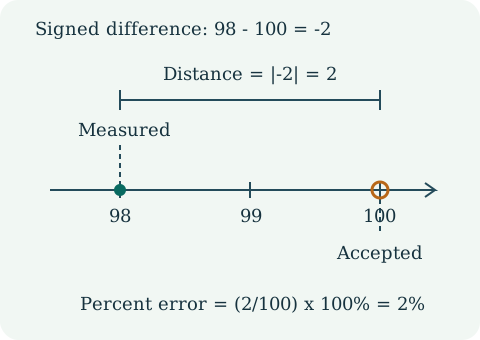
Percent error measures the distance between a measured value m and an accepted value a relative to the accepted magnitude. First find the signed difference d = m - a. Then take magnitudes and compute E = |m-a|/|a| times 100 percent. A nonzero accepted value is necessary because the reference scale cannot be zero.
The signed difference tells direction: negative means the measurement is numerically below the accepted value and positive means above. Percent error discards that direction and is always nonnegative. A negative accepted value still uses its positive magnitude in the denominator. Errors can exceed 100 percent when the distance exceeds the accepted magnitude.
Worked examples
Read the reasoning, or load an example into the calculator.
A measurement below the reference
98 - 100 = -2, so signed difference is -2 units. Percent error is |-2|/|100| times 100 percent = 2 percent.
A negative reference
For measured -12 and accepted -10, signed difference is -2. Use |-10| = 10 in the denominator: 2/10 times 100 percent = 20 percent.
More than one hundred percent
Measured 25 versus accepted 10 gives difference 15 and relative error 15/10 = 3/2, so percent error is 150 percent.
Try it without the calculator
Three questions for practice, not a graded school assessment. Your answers stay on this page and are not saved.
Original Testinar learning content. This local preview is awaiting final review before publication.