Grades 6-8Free, no account needed
Probability calculator
Find an event probability, its complement, or the probability of two independent events both occurring, with exact fractions and percents.
Try your problem
Supported inputs and limits
Each total is a whole number 1-1,000,000 and each favorable count is a whole number 0 through its total. Only a single event, its complement and two assumed-independent events are supported. Exact fractions and percent strings use parentheses for repeating digits. No conditional or dependent-event model. Paste up to 200 characters: probability: 2/6; complement: 2/6; or independent: 1/2 and 1/3.
Step by step
Understand the method
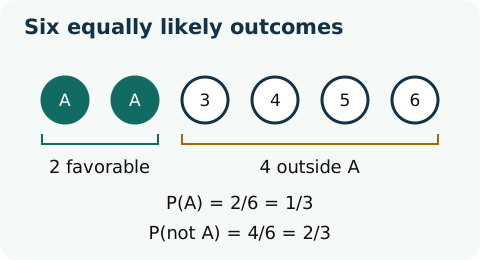
For a finite set of equally likely outcomes, probability is favorable outcomes divided by total outcomes. The numerator cannot exceed the denominator. A probability of zero means no listed outcome is favorable; a probability of one means every listed outcome is favorable. Multiplying a probability by 100 expresses the same chance as a percent.
The complement contains exactly the outcomes outside the event, so P(not A) = 1 - P(A). For two independent events, P(A and B) = P(A) x P(B). Independence means that learning whether one occurred does not change the other's probability; counts alone cannot establish it. Drawing twice with replacement can be independent, while drawing without replacement usually is not.
Worked examples
Read the reasoning, or load an example into the calculator.
Two favorable faces
2 favorable outcomes out of 6 give 2/6 = 1/3 = 33.(3)%. The complement is 2/3.
The event does not happen
If 3 of 8 outcomes favor A, the other 5 favor not A: 1 - 3/8 = 5/8 = 62.5%.
Two independent successes
For independent probabilities 1/2 and 1/3, favorable pairs = 1 x 1 and total pairs = 2 x 3. Both occur with probability 1/6 = 16.(6)%.
Try it without the calculator
Three questions for practice, not a graded school assessment. Your answers stay on this page and are not saved.
Original Testinar learning content. This local preview is awaiting final review before publication.