Grades 5-8Free, no account needed
Decimal arithmetic calculator
Add, subtract, multiply or divide two decimals or fractions exactly, with live rational steps and a value comparison.
Try your problem
Supported inputs and limits
Two signed finite decimals (at most 9 decimal places) or integer fractions; no mixed or repeating-decimal input. At most 40 characters per value, magnitude at most 1 billion, unreduced numerator magnitude at most 10^18 and denominator magnitude at most 10^12. Zero denominators and zero divisors are rejected. Paste syntax: 0.1 + 0.2 or 1/3 divided by 2/5; exactly one binary operation, at most 200 characters. When dividing fractions with /, put spaces around the operation, as in 1/2 / 3/4; ambiguous chains like 1/2/3 are rejected. Bar positions are approximate; the fraction answer is exact.
Step by step
Understand the method
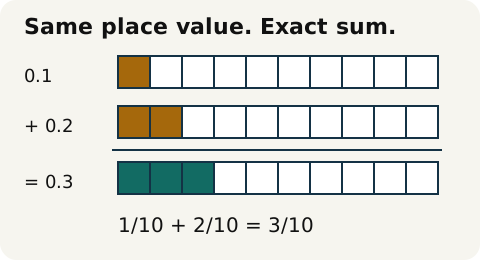
A finite decimal is an exact fraction whose denominator is a power of ten. For example, 0.125 is 125/1000, which reduces to 1/8. Working with those fractions avoids the tiny errors that can occur when decimals are stored as binary approximations.
Addition and subtraction use a common denominator, just as written decimal addition aligns equal place values. Multiplication multiplies numerators and denominators; division multiplies by the reciprocal of a nonzero divisor. A terminating answer is displayed as an exact decimal, while a nonterminating answer keeps its exact fraction.
Worked examples
Read the reasoning, or load an example into the calculator.
Add tenths exactly
0.1 = 1/10 and 0.2 = 2/10. Their sum is 3/10 = 0.3.
Multiply a signed decimal
-1.25 = -5/4 and 0.8 = 4/5, so the product is -1.
Keep a repeating quotient exact
0.2 / 0.6 = (1/5) / (3/5) = 1/3; the decimal repeats as 0.(3).
Try it without the calculator
Three questions for practice, not a graded school assessment. Your answers stay on this page and are not saved.
Original Testinar learning content. This local preview is awaiting final review before publication.