Grades 7-8 & algebraFree, no account needed
Scientific notation calculator
Convert a decimal or scientific notation, or add, subtract, multiply and divide scientific values with exact normalization.
Try your problem
Supported inputs and limits
Each value accepts a signed finite-decimal coefficient of magnitude at most 1 billion and at most 9 decimal places, optionally followed by eN or x 10^N. Each input exponent is an integer from -30 to 30; normalized result exponents may extend to -78 through 78. At most 64 characters per value; no fraction, repeating or mixed input. Zero divisors are rejected. Paste syntax: convert 45000, 6.02e23, or 6e4 / 2e-3, with spaces around a binary operator; at most 200 characters. Exact fractional output coefficients are allowed and decimal repetition uses parentheses.
Step by step
Understand the method
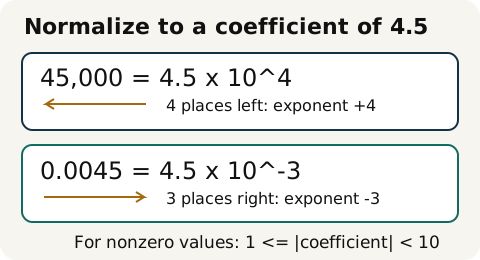
Scientific notation writes a nonzero value as c x 10^e, where e is an integer and 1 <= |c| < 10. Moving the decimal point left increases the exponent; moving it right decreases the exponent. For example, 45000 = 4.5 x 10^4 and 0.0045 = 4.5 x 10^-3. Zero uses the convention 0 x 10^0 here.
To multiply, multiply coefficients and add exponents; to divide, divide coefficients and subtract exponents. Addition and subtraction first align powers of ten. Normalize the result again after any operation. If division produces a repeating coefficient, an exact fraction coefficient preserves the value instead of silently rounding it.
Worked examples
Read the reasoning, or load an example into the calculator.
Normalize a large decimal
45000 = 4.5 x 10^4; the coefficient is at least 1 and below 10.
Align before adding
2.5e3 + 7.5e2 = 2500 + 750 = 3250 = 3.25 x 10^3.
Subtract exponents in division
6e4 / 2e-3 = (6/2) x 10^(4 - (-3)) = 3 x 10^7.
Try it without the calculator
Three questions for practice, not a graded school assessment. Your answers stay on this page and are not saved.
Original Testinar learning content. This local preview is awaiting final review before publication.