Grades 6-8Free, no account needed
Integer exponent calculator
Raise a signed decimal or fraction to an integer power, including negative and zero exponents, with exact answers and a power table.
Try your problem
Supported inputs and limits
Integer exponents from -12 to 12. Bases are signed finite decimals with at most 9 places or integer fractions, at most 40 characters, magnitude at most 1 billion, unreduced numerator magnitude at most 10^18 and denominator magnitude at most 10^12. No mixed/repeating-decimal input. 0^0 and zero to a negative power are undefined and rejected. Paste syntax: (2/3)^-2, (-2)^4, or 2^3; signed negative or fractional bases require parentheses. At most 200 pasted characters. Power tables are exact, not sampled graphs.
Step by step
Understand the method
A positive integer exponent counts repeated factors of the entire base: (2/3)^3 = (2/3) x (2/3) x (2/3) = 8/27. Parentheses matter for a negative base. For instance, (-2)^2 is 4 because both negative factors belong to the base.
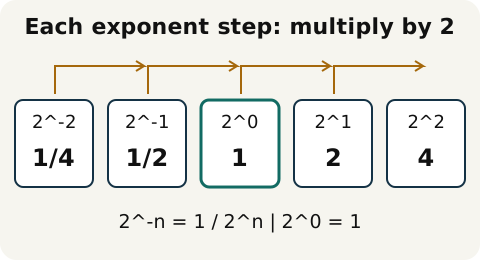
For a nonzero base, decreasing the exponent by one divides the value by the base. This gives a^0 = 1 and a^-n = 1/a^n. Zero cannot have a negative exponent because that would require division by zero; this tool explicitly treats 0^0 as undefined.
Worked examples
Read the reasoning, or load an example into the calculator.
Reciprocal power
(2/3)^2 = 4/9, so (2/3)^-2 = 9/4 = 2.25.
Odd power of a negative base
(-1.5)^3 = (-3/2)^3 = -27/8 = -3.375.
A nonzero base to zero
5^0 = 5^1 / 5^1 = 5/5 = 1. Dividing a nonzero power by itself gives the multiplicative identity.
Try it without the calculator
Three questions for practice, not a graded school assessment. Your answers stay on this page and are not saved.
Original Testinar learning content. This local preview is awaiting final review before publication.