Grades 8-11Free, no account needed
Arithmetic and geometric sequence calculator
Find the nth term and the sum of the first n terms of an arithmetic or geometric sequence using exact arithmetic.
Try your problem
Supported inputs and limits
n is a whole number from 1 to 100. The first term and difference or ratio have magnitude at most 10,000 and reduced numerator/denominator at most 1,000,000. Results are exact fractions, potentially hundreds of digits. The table previews up to eight terms plus nth term and sum. Only the active mode's difference or ratio is read. Paste at most 200 characters: arithmetic(3,2,10) or geometric(2,3,5), ordered first term, difference/ratio, n; pasted numbers use integers, decimals or integer fractions.
Step by step
Understand the method
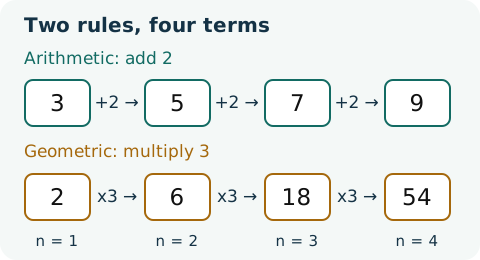
An arithmetic sequence adds the same common difference d at every step. Counting from a_1, term n is a_n = a_1 + (n - 1)d. Pairing the first and last terms gives S_n = n(a_1 + a_n)/2. Negative differences make descending sequences, and a zero difference repeats the first term.
A geometric sequence multiplies by a common ratio r at every step. Its nth term is a_n = a_1 r^(n - 1). For r other than 1, its finite partial sum is S_n = a_1(1 - r^n)/(1 - r). When r = 1, simply use n a_1. Negative ratios alternate signs; a zero ratio leaves the first term followed by zeros. Term 1 is the supplied first value, with r^0 = 1 in the nth-term formula even when r = 0.
Worked examples
Read the reasoning, or load an example into the calculator.
An arithmetic progression
Starting at 3 and adding 2 gives a_10 = 3 + 9(2) = 21. S_10 = 10(3 + 21)/2 = 120.
A geometric progression
Starting at 2 with ratio 3 gives a_5 = 2(3^4) = 162. S_5 = 2(1 - 3^5)/(1 - 3) = 242.
Alternating signs
With first term 4 and ratio -1, the first six terms are 4, -4, 4, -4, 4, -4. Thus a_6 = -4 and S_6 = 0.
Try it without the calculator
Three questions for practice, not a graded school assessment. Your answers stay on this page and are not saved.
Original Testinar learning content. This local preview is awaiting final review before publication.