Grades 8-10Free, no account needed
Binomial multiplication calculator
Expand (ax + b)(cx + d) with four exact products and a clear combination of the middle terms.
Try your problem
Supported inputs and limits
Two binomials in one variable only, (ax + b)(cx + d). Each input has magnitude at most 10,000 and reduced numerator/denominator at most 1,000,000. Zero, signed and rational coefficients are supported exactly; zero terms are omitted. Paste at most 200 characters: binomial(2,3,1,-4); pasted numbers use integers, decimals or integer fractions.
Step by step
Understand the method
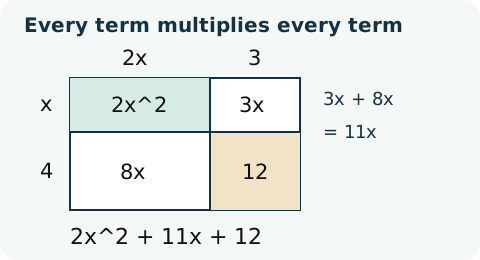
The distributive property sends every term in the first binomial to every term in the second. For (ax + b)(cx + d), those products are acx^2, adx, bcx and bd. The x^2 term comes from x times x, not from adding exponents to constants.
Only like terms can be combined. The two x terms share the same variable power, so their coefficients add to ad + bc. The final expression is acx^2 + (ad + bc)x + bd. An area grid organizes the four products for positive lengths; the algebraic distribution still works when coefficients are zero, negative or fractional.
Worked examples
Read the reasoning, or load an example into the calculator.
Combine signed middle terms
(2x + 3)(x - 4) = 2x^2 - 8x + 3x - 12 = 2x^2 - 5x - 12.
A difference of squares
(x + 5)(x - 5) = x^2 - 5x + 5x - 25 = x^2 - 25. The middle terms cancel.
Fractional coefficients
(x/2 + 1)(2x + 3) = x^2 + 3x/2 + 2x + 3 = x^2 + 7x/2 + 3.
Try it without the calculator
Three questions for practice, not a graded school assessment. Your answers stay on this page and are not saved.
Original Testinar learning content. This local preview is awaiting final review before publication.