Grades 7-8 & algebraFree, no account needed
Square root simplifier
Simplify the square root of a nonnegative integer, extract its largest square factor, and compare an exact radical with a decimal approximation.
Try your problem
Supported inputs and limits
Nonnegative integer radicands from 0 through 1,000,000,000,000 (10^12), at most 13 digits with an optional plus sign. Negative, decimal, fractional and complex radicands are not accepted. Exact simplified radicals and perfect-square roots are preserved; irrational decimals are approximated to 12 significant digits. Paste syntax: sqrt(72), at most 200 characters.
Step by step
Understand the method
The principal square root of a nonnegative number is the nonnegative number whose square is the original value. Thus sqrt(49) = 7, not -7. The equation x^2 = 49 has two solutions, but the square-root symbol itself names only the principal root.
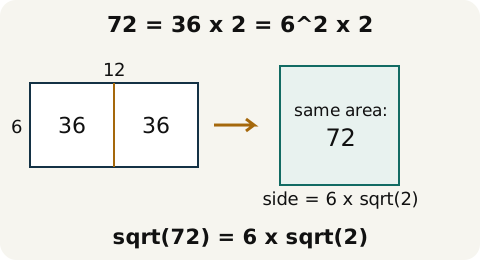
Factor a radicand into a perfect square and a square-free factor. For example, 72 = 36 x 2, so sqrt(72) = sqrt(36) x sqrt(2) = 6 x sqrt(2). This radical is exact. Its decimal expansion does not terminate or repeat, so a displayed decimal must be labeled approximate.
Worked examples
Read the reasoning, or load an example into the calculator.
Extract a square factor
72 = 36 x 2, so sqrt(72) = 6 x sqrt(2), approximately 8.48528137424.
A perfect square
144 = 12^2, so its nonnegative principal square root is 12.
A square-free radicand
17 has no square factor above 1. sqrt(17) is already simplified, approximately 4.12310562562.
Try it without the calculator
Three questions for practice, not a graded school assessment. Your answers stay on this page and are not saved.
Original Testinar learning content. This local preview is awaiting final review before publication.