Grade 8 & geometryFree, no account needed
Distance & midpoint calculator
Find the exact midpoint and distance between two coordinate points, with rational steps and a labeled segment plot.
Try your problem
Supported inputs and limits
Two-dimensional Cartesian coordinates only, each from -10,000 through 10,000 with reduced denominator at most 1,000,000. No geographic distance or unit conversion. Identical points allowed. Exact radicals may remain unsimplified; irrational approximations use 10 significant digits. Plot positions are approximate; use equal axis scales to interpret lengths. Paste at most 200 characters: distance -2 1 4 9, in x1 y1 x2 y2 order. Pasted numbers must have no internal spaces; field inputs also accept base-engine mixed and repeating numbers.
Step by step
Understand the method
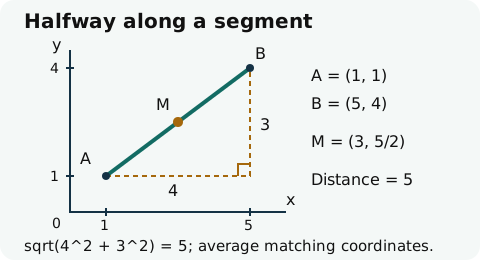
The horizontal and vertical changes between two points act like legs of a right triangle. Their squares add to the square of the straight-line distance. Thus d = sqrt((x2-x1)^2 + (y2-y1)^2). A distance is never negative, even when a coordinate change is negative.
The midpoint is halfway along the segment. Average the two x-coordinates and separately average the two y-coordinates: M = ((x1+x2)/2, (y1+y2)/2). Fractions keep these averages exact. Identical points are allowed: the distance is zero and the midpoint is the point itself.
Worked examples
Read the reasoning, or load an example into the calculator.
A 3-4-5 segment
Changes are 4 and 3, so d = sqrt(16 + 9) = 5. M = (3, 5/2).
Signed fractional coordinates
From (-1/2, -2) to (3/2, 2), changes are 2 and 4. Distance is sqrt(20), approximately 4.472135955, and midpoint is (1/2, 0).
The same point twice
Both changes are zero, so distance is 0. Averaging (2, -3) with itself returns midpoint (2, -3).
Try it without the calculator
Three questions for practice, not a graded school assessment. Your answers stay on this page and are not saved.
Original Testinar learning content. This local preview is awaiting final review before publication.