Grades 6-9Free, no account needed
Triangle area calculator
Use a base and perpendicular height, or three valid side lengths with Heron's formula, to find exact triangle area.
Try your problem
Supported inputs and limits
Every input dimension must be positive and at most 10,000, with reduced denominator at most 1,000,000. Three-side mode requires strict triangle inequalities. One common unit, no conversion. Exact radicals may remain unsimplified; irrational approximations have 10 significant digits. Field numbers may use fractions, decimals or base-engine mixed/repeating forms. Paste at most 200 characters: triangle base-height 8 5 cm or triangle heron 3 4 5 cm. Pasted numbers have no internal spaces; units: units, cm, m, in, ft.
Step by step
Understand the method
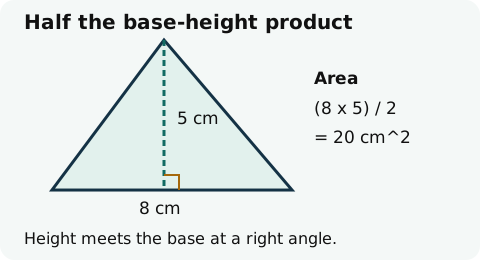
A triangle occupies half the area of a parallelogram with the same base and perpendicular height. Multiply the base by that height and divide by two. A sloping side is not usually the height: height meets the base, or its extension, at a right angle.
When only three sides are known, first check that each pair sums to more than the third. Then let s be half the perimeter. Heron's formula is A = sqrt(s*(s-a)*(s-b)*(s-c)). The quantity inside the square root has fourth-power length units, so its square root has square units.
Worked examples
Read the reasoning, or load an example into the calculator.
Base and height
A = (8 x 5)/2 = 20 cm^2. The height is perpendicular to the 8 cm base.
Three sides
For sides 3, 4 and 5 m, s = 6 m. A = sqrt(6 x 3 x 2 x 1) = 6 m^2.
An equilateral triangle
For three sides of 2 units, s = 3 and A = sqrt(3) units^2, approximately 1.732050808 units^2.
Try it without the calculator
Three questions for practice, not a graded school assessment. Your answers stay on this page and are not saved.
Original Testinar learning content. This local preview is awaiting final review before publication.