Grade 8 & geometryFree, no account needed
Pythagorean theorem calculator
Find a right triangle's hypotenuse or missing leg, with exact rational or radical answers and a square check.
Try your problem
Supported inputs and limits
Right triangles only. Known lengths must be positive and at most 10,000, with reduced denominator at most 1,000,000. The computed hypotenuse may exceed 10,000. Exact radicals may remain unsimplified; approximate roots use 10 significant digits. All lengths use the same unit; no conversion. Paste at most 200 characters: pythagorean hypotenuse 3 4 cm or pythagorean missing-leg 5 13 cm (known leg, then hypotenuse). Paste fractions without internal spaces; units: units, cm, m, in, ft.
Step by step
Understand the method
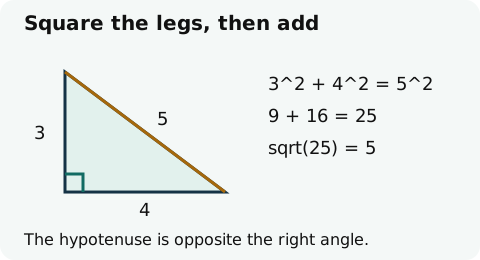
In a right triangle, the side opposite the right angle is the hypotenuse c. The two perpendicular sides are legs a and b. The Pythagorean theorem relates their lengths by a^2 + b^2 = c^2; it does not apply to every triangle.
To find c, add the leg squares and take the positive square root. To find b from a and c, subtract a^2 from c^2 before taking the positive square root. A perfect rational square has an exact rational root; otherwise an exact radical and a labeled decimal approximation describe the same length.
Worked examples
Read the reasoning, or load an example into the calculator.
The 3-4-5 triangle
c^2 = 3^2 + 4^2 = 25, so c = 5 cm.
Recover a missing leg
With a = 5 m and c = 13 m, b^2 = 169 - 25 = 144, so b = 12 m.
An irrational length
Two unit legs give c^2 = 2, so c = sqrt(2) units, approximately 1.414213562 units.
Try it without the calculator
Three questions for practice, not a graded school assessment. Your answers stay on this page and are not saved.
Original Testinar learning content. This local preview is awaiting final review before publication.