Grades 4-6Free, no account needed
Greatest common factor calculator
Find the GCF of two to six whole numbers with prime-factor comparisons and explained pairwise steps.
Try your problem
Supported inputs and limits
Enter 2 to 6 positive whole numbers, each at most 1,000,000. This pilot does not accept zero or negative values for the GCF/LCM list tools.
Step by step
Understand the method
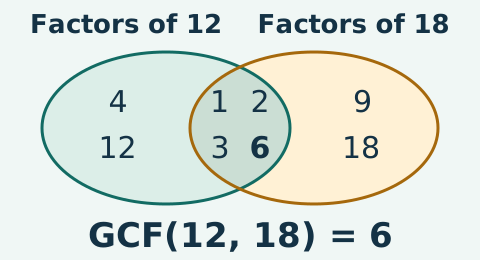
A common factor divides each number without a remainder. The greatest common factor is the largest positive common factor.
The Euclidean algorithm repeatedly replaces a pair by the smaller number and the remainder. The last nonzero remainder is the GCF. For a longer list, apply the GCF to each pair in turn.
Worked examples
Read the reasoning, or load an example into the calculator.
Three numbers
GCF(48,180) = 12; GCF(12,72) = 12.
Relatively prime numbers
14 and 25 share only the positive factor 1.
One number divides the other
24 is a factor of 96, so their GCF is 24.
Try it without the calculator
Three questions for practice, not a graded school assessment. Your answers stay on this page and are not saved.
Original Testinar learning content. This local preview is awaiting final review before publication.