Grades 4-6Free, no account needed
Prime factorization calculator
Break a whole number into prime factors using a visible division ladder.
Try your problem
Supported inputs and limits
Whole numbers from 2 to 1,000,000. Repeated prime factors are deliberately shown separately.
Step by step
Understand the method
A prime number has exactly two positive factors: 1 and itself. A composite number can be written as a product of smaller positive integers greater than 1.
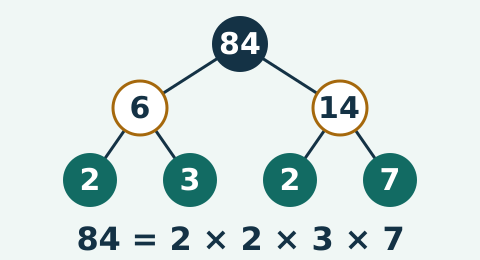
Divide by small primes until the remaining quotient is 1. The factors on the ladder are prime factors; their product reconstructs the original number.
Worked examples
Read the reasoning, or load an example into the calculator.
A composite number
84 / 2 = 42, / 2 = 21, / 3 = 7, / 7 = 1. Thus 84 = 2 x 2 x 3 x 7.
A prime input
97 has no divisor greater than 1 up to its square root, so it is prime.
A prime power
64 = 2 x 2 x 2 x 2 x 2 x 2.
Try it without the calculator
Three questions for practice, not a graded school assessment. Your answers stay on this page and are not saved.
Original Testinar learning content. This local preview is awaiting final review before publication.