Grades 8-11Free, no account needed
Regular polygon area calculator
Find exact perimeter and trigonometric apothem, circumradius and area for a regular3-100-gon, showing all vertices.
Try your problem
Supported inputs and limits
Integer n=3..100; common side1/1000000..1000000. Side syntax<=24 characters,6 decimal places or integer fractions with positive denominator, parts<=12 digits, reduced denominator<=1000000; no expressions. Perimeter exact rational; apothem/radius/area exact trigonometric expressions with numerical approximations to10 significant digits. All n vertices are drawn; radial guides may be limited. Plot coordinates approximate, length units consistent and area square units. Paste polygon(6;2), <=200 characters.
Step by step
Understand the method
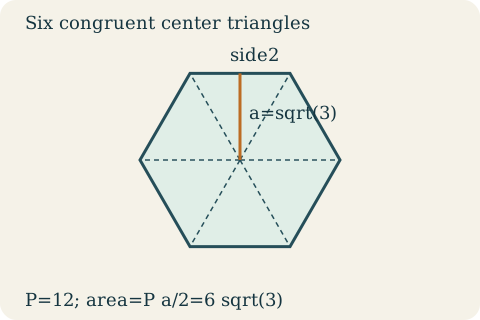
A regular convex polygon has equal sides and angles. Joining its center to all n vertices creates n congruent triangles. Their bases total the perimeter P=ns and their perpendicular height is the apothem a, so their combined area is K=Pa/2.
Bisect a center triangle: tan(pi/n)=(s/2)/a, giving a=s/(2 tan(pi/n)). Circumradius is R=s/(2 sin(pi/n)). Vertices are (R cos(2 pi i/n),R sin(2 pi i/n)) for i=0..n-1. Independently, K=n R^2 sin(2 pi/n)/2. Trigonometric arguments in these formulas are radians.
Worked examples
Read the reasoning, or load an example into the calculator.
A regular hexagon
n=6,s=2 gives P=12,a=sqrt(3),R=2,K=6 sqrt(3), approximately10.39230485.
A square cross-check
n=4,s=3 gives a=3/2,P=12. Area=12(3/2)/2=9, agreeing with s^2.
An equilateral triangle
n=3,s=2 gives perimeter6,apothem sqrt(3)/3 and area sqrt(3); each central angle is120 degrees.
Try it without the calculator
Three questions for practice, not a graded school assessment. Your answers stay on this page and are not saved.
Original Testinar learning content. This local preview is awaiting final review before publication.