Grades 6-8Free, no account needed
Volume & surface area calculator
Calculate volume and total surface area for a rectangular prism, cube or closed right circular cylinder.
Try your problem
Supported inputs and limits
Only closed rectangular prisms, cubes and right circular cylinders. Every input dimension must be positive and at most 10,000, with reduced denominator at most 1,000,000. One common length unit; no conversion, open containers or composite solids. Pi answers are exact; approximate values use 10 significant digits. Paste at most 200 characters: volume prism 2 3 4 cm (length width height), volume cube 3 m, or volume cylinder 2 5 cm (radius height). Paste numbers have no internal spaces; units: units, cm, m, in, ft.
Step by step
Understand the method
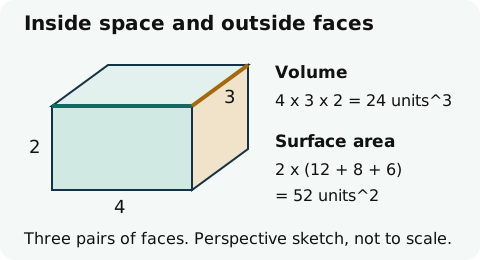
Volume measures three-dimensional space in cubic units. For a rectangular prism, multiply length, width and height. Surface area measures the outside in square units: add two copies of each face area, giving S = 2*(l*w + l*h + w*h). A cube has all three dimensions equal.
For a right circular cylinder, multiply the circular base area pi*r^2 by height to get volume. The curved surface unwraps into a rectangle whose width is circumference 2*pi*r and whose height is h. A closed cylinder includes two circular ends, so its total surface area is 2*pi*r^2 + 2*pi*r*h.
Worked examples
Read the reasoning, or load an example into the calculator.
A rectangular prism
For 4 x 3 x 2 cm, V = 24 cm^3 and S = 2*(12 + 8 + 6) = 52 cm^2.
A cube
A 3 m edge gives V = 3^3 = 27 m^3 and S = 6 x 3^2 = 54 m^2.
A closed cylinder
For r = 2 in and h = 5 in, V = 20*pi in^3; S = 8*pi + 20*pi = 28*pi in^2.
Try it without the calculator
Three questions for practice, not a graded school assessment. Your answers stay on this page and are not saved.
Original Testinar learning content. This local preview is awaiting final review before publication.