Grades 6-12Free, no account needed
Weighted average calculator
Combine values with nonnegative weights, showing exact products, normalized contributions and a weight-balance plot with zero-weight values identified.
Try your problem
Supported inputs and limits
Enter 1-20 comma-separated values and the same number of weights in matching order; each list at most 520 characters. Values range from -1000000 to 1000000; weights from 0 to 1000000, with positive sum. Scalars are signed integers, decimals with 1-6 places, or integer fractions with positive denominator; at most 24 characters and 12 digits per numerator/denominator part, reduced denominator at most 1000000. No expressions, mixed numbers, repeating decimals or exponents. Products, normalized contributions and mean are exact rationals. Paste weighted(70,80,90;1,2,1), case-sensitive and at most 200 characters. Stem heights represent weights; coincident values can overlap but every row remains in the exact table. Coordinates are approximate.
Step by step
Understand the method
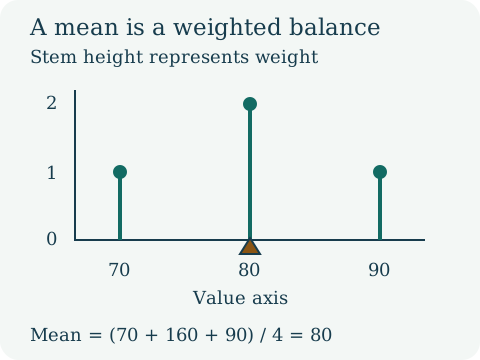
A weighted mean gives each value an influence proportional to its weight. Add the products of weights and values, then divide by the sum of weights, not by the number of rows.
Weights need not total 1 or 100. Dividing each weight by the positive total creates normalized weights that sum to 1. Each normalized weight times its value is that row's contribution to the final mean.
Nonnegative weights make the mean a balance point between the smallest and largest positively weighted values. A zero-weight value has no influence. Scaling every weight by the same positive factor does not change the mean.
Worked examples
Read the reasoning, or load an example into the calculator.
Different assessment weights
Values 70,80,90 with weights 1,2,1 give products 70,160,90. Their sum 320 divided by total weight 4 gives mean 80.
Fractional weights
Values 2 and 4 with weights 1/4 and 3/4 give contributions 1/2 and 3. Total weight is 1, so the exact mean is 7/2.
Ignore a zero-weight outlier
Values -100,10,20 with weights 0,1,3 give mean (0+10+60)/4 = 35/2. The -100 value has no influence; the mean is between 10 and 20.
Try it without the calculator
Three questions for practice, not a graded school assessment. Your answers stay on this page and are not saved.
Original Testinar learning content. This local preview is awaiting final review before publication.