What is \(486+237\)?
- \(613\)
- \(713\)
- \(723\)
- \(624\)


Students will add and subtract within 1,000 using place-value strategies and reliable algorithms.
What is \(486+237\)?
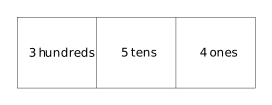
Which number does this place-value chart show?
\(245+318=?\)
Ben has \(127\) stickers. He gets \(234\) more stickers. How many stickers does Ben have now?
What is \(542-218\)?
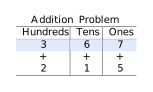
Using the place-value chart, what is \(367+215\)?
\(308+175=?\)
What is \(635-241\)?
Add the ones (\(6+7=13\), write \(3\), carry \(1\)), tens (\(8+3+1=12\), write \(2\), carry \(1\)), hundreds (\(4+2+1=7\)). Answer: \(723\).
Reading the chart: \(3\) hundreds is \(300\), \(5\) tens is \(50\), \(4\) ones is \(4\). Total: \(300+50+4=354\).
Add ones: \(5+8=13\) (write \(3\), carry \(1\)). Add tens: \(4+1+1=6\). Add hundreds: \(2+3=5\). Answer: \(563\).
Add: \(127+234=361\). Ones: \(7+4=11\) (write \(1\), carry \(1\)). Tens: \(2+3+1=6\). Hundreds: \(1+2=3\).
Subtract: ones (\(2-8\) requires regrouping, so \(12-8=4\)), tens (\(3-1=2\)), hundreds (\(5-2=3\)). Answer: \(324\).
Ones: \(7+5=12\) (write \(2\), carry \(1\)). Tens: \(6+1+1=8\). Hundreds: \(3+2=5\). Answer: \(582\).
Ones: \(8+5=13\) (write \(3\), carry \(1\)). Tens: \(0+7+1=8\). Hundreds: \(3+1=4\). Answer: \(483\).
Ones: \(5-1=4\). Tens: \(3-4\) requires regrouping, so \(13-4=9\). Hundreds: \(5-2=3\). Answer: \(394\).
