A shape is made of two rectangles. Rectangle 1 has area \(12\) sq units, and Rectangle 2 has area \(15\) sq units. What is the total area?
- \(15\) sq units
- \(24\) sq units
- \(27\) sq units
- \(180\) sq units


Students will find the area of composite figures by decomposing them and adding partial areas.
A shape is made of two rectangles. Rectangle 1 has area \(12\) sq units, and Rectangle 2 has area \(15\) sq units. What is the total area?
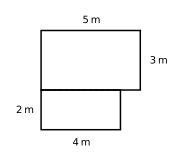
An L-shaped garden is divided into two rectangles. The top rectangle has length \(5\) m and width \(3\) m. The bottom rectangle has length \(4\) m and width \(2\) m. What is the total area of the garden?
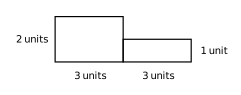
A composite shape is made by joining two rectangles. What is the total area?
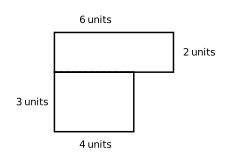
A floor plan shows an L-shaped room. One part is \(4\) units long and \(3\) units wide. The other part is \(6\) units long and \(2\) units wide. What is the total floor area?
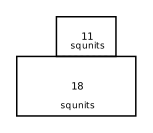
A composite shape has areas of \(18\) sq units and \(11\) sq units. Find the total area.
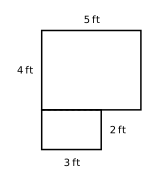
An L-shaped patio is shown with dashed lines dividing it into two rectangles. The first rectangle is \(5\) ft by \(4\) ft. The second is \(3\) ft by \(2\) ft. What is the total area of the patio?
Which shows a correct way to find the total area of an L-shaped figure?
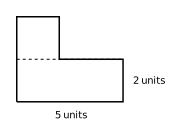
An L-shaped garden with dashed decomposition lines shows: The bottom part is \(5\) units by \(2\) units. The top part is \(2\) units by \(2\) units. What is the total area?
When a composite shape is divided into non-overlapping rectangles, the total area equals the sum of the individual rectangle areas. Here: \(12+15=27\) square units.
Find each rectangle: top is \(5 \times 3 = 15\) sq m; bottom is \(4 \times 2 = 8\) sq m. Total: \(15+8=23\) sq m.
Left rectangle: \(3 \times 2 = 6\) sq units. Right rectangle: \(3 \times 1 = 3\) sq units. Total: \(6+3=9\) sq units.
Part 1: \(4 \times 3 = 12\) sq units. Part 2: \(6 \times 2 = 12\) sq units. Total: \(12+12=24\) sq units.
Add the areas: \(18+11=29\) square units. Choice B (only one part) and C (subtraction) are common errors.
Top rectangle: \(5 \times 4 = 20\) sq ft. Bottom rectangle: \(3 \times 2 = 6\) sq ft. Total: \(20+6=26\) sq ft.
Composite shapes are found by dividing them into non-overlapping rectangles, finding each area, and adding them together. Choice A fails because an L-shape is not a single rectangle. Choices C and D are incorrect methods.
Bottom: \(5 \times 2 = 10\) sq units. Top: \(2 \times 2 = 4\) sq units. Total: \(10+4=14\) sq units.
