A garden is \(7\) feet long and \(5\) feet wide. What is its area?
- \(12\) sq ft
- \(35\) sq ft
- \(24\) sq ft
- \(70\) sq ft


Students will find the area of a rectangle by multiplying whole-number side lengths.
A garden is \(7\) feet long and \(5\) feet wide. What is its area?
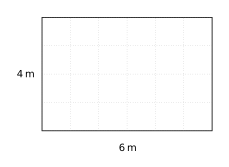
A rectangular rug is \(6\) meters long and \(4\) meters wide. What is the area of the rug?
A classroom floor is shaped like a rectangle with a length of \(9\) feet and a width of \(8\) feet. What is the area of the classroom floor?
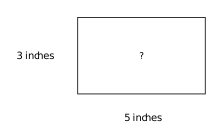
What is the area of this rectangle?
Sam needs to paint a poster that is \(10\) inches wide and \(8\) inches tall. What is the total area Sam needs to paint?
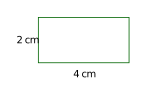
Find the area of the rectangle shown above.
A rectangular tile is \(7\) inches long and \(3\) inches wide. How much area does one tile cover?
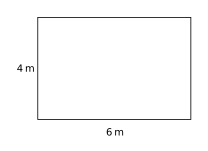
A rectangular parking spot measures \(6\) meters by \(4\) meters. What is its area?
Area \(=\) length \(\times\) width \(=7\times5=35\) square feet. Choice A (12) is the sum \(7+5\); Choice C (24) is common product error; Choice D (70) is double the area.
Area \(=\) length \(\times\) width \(=6\times4=24\) square meters. Choice A (10) is the sum; C (20) is 4×5 miscomputation; D (12) is 6×2.
Area \(=\) length \(\times\) width \(=9\times8=72\) square feet. Choice A (17) is the sum; C (64) is \(8\times8\); D (63) is \(9\times7\).
Area \(=\) length \(\times\) width \(=5\times3=15\) square inches. Choice A (8) is the sum; C (10) is \(5\times2\); D (12) is \(4\times3\).
Area \(=\) width \(\times\) height \(=10\times8=80\) square inches.
Area \(=\) length \(\times\) width \(=4\times2=8\) square centimeters. Choice A (6) is the sum; C (4) is one dimension; D (12) is \(4\times3\).
Area \(=\) length \(\times\) width \(=7\times3=21\) square inches.
Area \(=\) length \(\times\) width \(=6\times4=24\) square meters.
