Sam tiles a rectangle that is \(4\) tiles long and \(3\) tiles wide. How many tiles does he use in all?
- \(7\)
- \(12\)
- \(14\)
- \(24\)


Students will find the area of rectangles by tiling them with unit squares.
Sam tiles a rectangle that is \(4\) tiles long and \(3\) tiles wide. How many tiles does he use in all?
The rectangle is tiled with unit squares. How many unit squares are there?
A rectangle has \(5\) rows of unit squares and \(2\) columns of unit squares. What is the area?
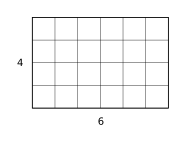
Count all the unit squares. What is the area?
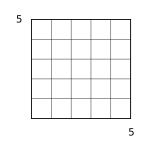
Ben tiles a square using unit squares. He puts \(5\) tiles in each row and \(5\) tiles in each column. How many tiles does he use?
How many unit squares are in this rectangle?
How many unit squares fit in this tall rectangle?
This square is tiled with unit squares. How many are there?
Multiply length × width: \(4 \times 3 = 12\) tiles. Shows tiling result matches multiplication.
Count rows and columns: \(6 \times 4 = 24\) square units. Bridge from visual tiling to multiplication.
\(5\) rows × \(2\) columns = \(5 \times 2 = 10\) square units. A is sum error.
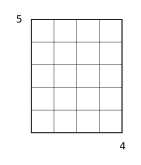
Visual grid: \(4\) wide × \(5\) tall = \(20\) square units.
Square: \(5 \times 5 = 25\) tiles. Equal row and column count.
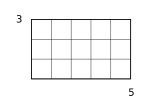
\(5 \times 3 = 15\) square units.
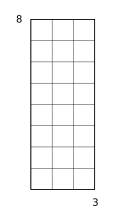
Tall rectangle: \(3 \times 8 = 24\) square units. D is concatenation error.
Square tiling: \(5 \times 5 = 25\) square units.
