Which comparison is true?
- \(\frac{3}{5}>\frac{3}{4}\)
- \(\frac{3}{5}<\frac{3}{4}\)
- \(\frac{3}{4}<\frac{3}{5}\)
- \(\frac{3}{5}=\frac{3}{4}\)


Students will compare fractions with the same numerator or denominator and justify the comparison.
Which comparison is true?
Compare \(\frac{2}{3}\) and \(\frac{2}{4}\). Which is true?
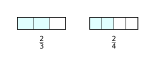
The bars show two fractions. Which is larger?
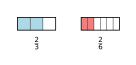
Which comparison is true?
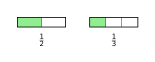
Using the bars, which is true?
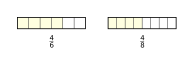
Compare \(\frac{4}{6}\) and \(\frac{4}{8}\). Which is true?
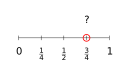
On the number line, the red dot is at the same position as which label?
Lily has \(\frac{3}{8}\) of a chocolate bar. Noah has \(\frac{3}{4}\) of the same size chocolate bar. Who has more?
When comparing fractions with the same numerator (3), look at the denominator: fifths are bigger pieces than fourths. So \(\frac{3}{5}\) (3 large pieces) is less than \(\frac{3}{4}\) (3 slightly larger pieces). Key rule: smaller denominator = bigger pieces.
Strategy: same numerator (2), so compare denominators. Thirds are bigger pieces than fourths (a whole divided by 3 gives bigger parts than divided by 4). Visual check: the blue bar (2/3) covers more area than the bar would if it were 2/4. Rule: when numerators match, smaller denominator wins.
Visual reasoning: same numerator (2), so both take 2 pieces. But \(\frac{2}{3}\) divides the whole into 3 parts (each third is large), while \(\frac{2}{6}\) divides into 6 parts (each sixth is small). Comparing shaded amounts: 2 large pieces > 2 small pieces, so \(\frac{2}{3} > \frac{2}{6}\).
Same numerator (3), different denominators: fourths are bigger pieces than sixths (the bar is cut into fewer, larger pieces). Three fourths covers more area than three sixths.
Same numerator (1): both fractions take 1 piece from their bar. But the first bar is divided in half (larger piece), the second in thirds (smaller piece). One half > one third. Visually: the green shaded area is larger in the first bar.
Same numerator (4): sixths are bigger pieces than eighths. Comparing the shaded areas: 4 sixths covers more than 4 eighths. The fewer pieces the denominator divides into, the bigger each piece.
The dot is positioned at the third quarter mark on the number line, which is \(\frac{3}{4}\). This is greater than \(\frac{1}{2}\).
Same numerator (3), different denominators, same chocolate bar: fourths are larger pieces than eighths. So \(\frac{3}{4}\) is more than \(\frac{3}{8}\). Noah has more because he has 3 larger pieces.
