Which fraction is equivalent to \(\frac{1}{2}\)?
- \(\frac{1}{4}\)
- \(\frac{2}{4}\)
- \(\frac{2}{3}\)
- \(\frac{1}{3}\)


Students will explain fraction equivalence and compare fractions using visual models and number-line reasoning.
Which fraction is equivalent to \(\frac{1}{2}\)?
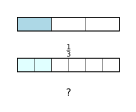
Look at the fraction bars. Which fraction is equivalent to \(\frac{1}{3}\)?
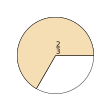
Which fraction is equivalent to \(\frac{2}{3}\)?
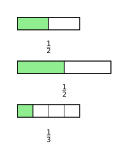
Look at the bars. Which statement is NOT true?
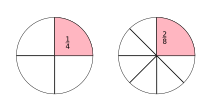
Look at the pies. Which statement is true?
Which fraction is equivalent to \(\frac{3}{4}\)?
Lily has 2 equal pieces of a sandwich. She eats 1 piece. What fraction did she eat?
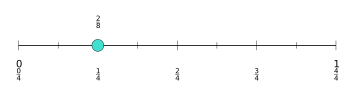
Which fraction is equivalent to \(\frac{1}{4}\)?
\(\frac{1}{2}\) and \(\frac{2}{4}\) represent the same amount. Both show half of a whole.
The shaded regions match. \(\frac{1}{3}\) and \(\frac{2}{6}\) are equivalent.
\(\frac{2}{3}\) and \(\frac{4}{6}\) represent the same amount. Both show two-thirds.
The first and second bars are equivalent. But the third bar shows \(\frac{1}{3}\), which is larger than \(\frac{1}{2}\), so all three do NOT show the same amount. Answer C is false.
Both pies show the same shaded region. \(\frac{1}{4}\) and \(\frac{2}{8}\) are equivalent.
\(\frac{3}{4}\) and \(\frac{6}{8}\) both show three-fourths of a whole.
Lily ate 1 out of 2 pieces, which is \(\frac{1}{2}\).
\(\frac{1}{4}\) and \(\frac{2}{8}\) both show one-quarter of a whole.
