On a number line from \(0\) to \(1\) divided into \(4\) equal parts, what fraction is at the second tick mark from \(0\)?
- \(\frac{1}{4}\)
- \(\frac{2}{4}\)
- \(\frac{3}{4}\)
- \(\frac{4}{4}\)


Students will understand fractions as numbers and locate them on a number line.
On a number line from \(0\) to \(1\) divided into \(4\) equal parts, what fraction is at the second tick mark from \(0\)?
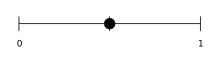
The dot marks a point on this number line. What fraction is it?
What fraction is at the third (last) tick mark on a 3-part number line from \(0\) to \(1\)?

On this number line, the distance from \(0\) to \(1\) is divided into \(6\) equal parts. The point shown is at which fraction?

On a number line from \(0\) to \(1\) with \(8\) equal parts, what fraction is marked by the dot?

A number line shows the distance from \(0\) to \(1\) split into \(4\) equal parts. Where is \(\frac{1}{4}\) located?

On a number line from \(0\) to \(1\) with \(3\) equal parts, the second tick mark from \(0\) represents which fraction?

A number line from \(0\) to \(1\) has \(6\) equal parts. The dot marks which fraction?

Each tick is \(\frac{1}{4}\) of the distance from \(0\) to \(1\). The second tick is \(2\) copies of \(\frac{1}{4}=\frac{2}{4}\).
The dot is at 1 tick out of 2 equal parts, so the fraction is \(\frac{1}{2}\).
The last tick mark shows all 3 parts: \(\frac{3}{3}=1\) (the whole).
Counting from left, the mark is at the \(2\)nd tick out of \(6\) equal parts, so it is \(\frac{2}{6}\).
The dot is at the \(5\)th mark out of \(8\) equal divisions, so the fraction is \(\frac{5}{8}\).
\(\frac{1}{4}\) is one part out of four equal parts, so it is at the first tick mark from \(0\).
The second tick from \(0\) is \(2\) parts out of \(3\) equal parts, so it represents \(\frac{2}{3}\).
Counting ticks from \(0\), the dot is at the \(4\)th mark out of \(6\) equal parts, so it is \(\frac{4}{6}\).
