Which fraction is equivalent to \(\frac{3}{4}\)?
- \(\frac{3}{8}\)
- \(\frac{4}{3}\)
- \(\frac{6}{8}\)
- \(\frac{1}{2}\)


Students will generate simple equivalent fractions using models, number lines, and multiplication patterns.
Which fraction is equivalent to \(\frac{3}{4}\)?
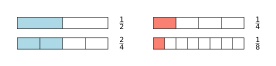
Look at the fraction bars below. Which fractions are equivalent?
Which fraction is equivalent to \(\frac{1}{3}\)?
Which fraction equals \(\frac{1}{2}\)?
Which fraction is NOT equivalent to \(\frac{2}{4}\)?
Which fraction is equivalent to \(\frac{1}{2}\) by multiplying numerator and denominator by 3?
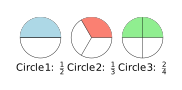
Which two circles show equivalent fractions?
\(\frac{1}{4}=\frac{2}{?}\). What number goes in the box?
If you divide a figure into 4 parts and shade 3, then divide each part in half, you get 8 parts with 6 shaded. So \(\frac{3}{4}=\frac{6}{8}\) because \(\frac{3\times2}{4\times2}=\frac{6}{8}\).
Both bars show the same shaded length. When you split each half into 2 equal parts, 1 half becomes 2 fourths. So \(\frac{1}{2}=\frac{2}{4}\).
Multiply numerator and denominator by 2: \(\frac{1\times2}{3\times2}=\frac{2}{6}\).
Multiply numerator and denominator by 4: \(\frac{1\times4}{2\times4}=\frac{4}{8}\).
\(\frac{2}{4}\) equals \(\frac{1}{2}\) (divide by 2). Choices A, B, and C are all equivalent to \(\frac{1}{2}\). Only \(\frac{2}{3}\) is different.
Multiply numerator and denominator by 3: \(\frac{1\times3}{2\times3}=\frac{3}{6}\).
Circle 1 shows \(\frac{1}{2}\) (half shaded) and Circle 3 shows \(\frac{2}{4}\) (half shaded). These are equivalent because \(\frac{1\times2}{2\times2}=\frac{2}{4}\).
The numerator was multiplied by 2 (from 1 to 2). Multiply the denominator by 2: \(4\times2=8\). So \(\frac{1}{4}=\frac{2}{8}\).
