Which situation can be represented by \(12\div3\)?
- \(12\) multiply by \(3\)
- \(3\) subtract from \(12\)
- How many groups of \(3\) make \(12\)
- \(12\) items shared equally among \(3\) groups


Students will interpret whole-number quotients as sharing equally or finding the number of equal groups.
Which situation can be represented by \(12\div3\)?
Which division sentence matches this picture?
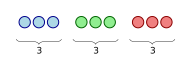
Ava has \(15\) stickers. She puts them equally into \(5\) envelopes. How many stickers does each envelope have?
Which number sentence matches "How many groups of \(4\) are in \(16\)?"
Which multiplication fact helps you solve \(10\div2=?\)
Sam bought \(18\) pencils. He wants to put them into \(3\) boxes equally. How many pencils go in each box?
Which number sentence represents "\(20\) items divided equally among \(4\) groups"?
Which division sentence shows "How many groups of \(2\) fit in \(14\)?"
\(12\div3\) asks "how many in each group when \(12\) items are shared equally among \(3\) groups?" Each group gets \(4\) items.
There are \(9\) circles total, divided into \(3\) equal groups. Each group has \(3\) circles, so \(9\div3=3\).
\(15\div5=3\). Sharing means dividing the total into equal groups.
"How many groups of \(4\)" is a measurement division problem. Divide \(16\) by \(4\) to find the number of groups.
Division and multiplication are inverse operations. Since \(2\times5=10\), then \(10\div2=5\).
\(18\div3=6\). Divide the total number of pencils by the number of boxes.
Dividing equally among groups means the total is shared into equal parts. Use division.
Measurement division finds how many groups. Divide the total by the group size.
