A bottle holds \(2000\) milliliters of juice. A glass holds about \(250\) milliliters. Which is the BEST estimate of how many glasses can be filled from the bottle?
- \(2\)
- \(4\)
- \(8\)
- \(12\)


Students will measure and estimate liquid volume and mass using liters, grams, and kilograms.
A bottle holds \(2000\) milliliters of juice. A glass holds about \(250\) milliliters. Which is the BEST estimate of how many glasses can be filled from the bottle?
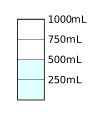
Lily measures water in a measuring cup. The cup shows \(500\) mL of water. Which amount equals \(500\) mL?
A bag of flour has a mass of \(2000\) grams. A block of butter has a mass of \(250\) grams. How many more grams does the flour weigh than the butter?
Noah has a watering can that holds \(3\) liters. He pours out \(1500\) mL to water the plants. How many milliliters of water are left in the can?
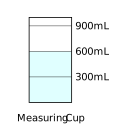
Ava fills a measuring cup to the \(600\) mL line with milk. She needs \(900\) mL total. How much more milk does she need to add?
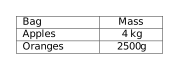
Which bag is heavier?
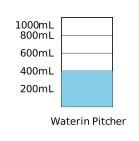
The pitcher shows \(400\) mL of water. Ben adds \(600\) mL more. How much water is in the pitcher now?
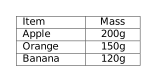
Mia weighs three items on a scale: Which item has the greatest mass?
Divide: \(2000\div250=8\) glasses.
Read directly from the measuring cup: \(500\) mL.
Subtract: \(2000 - 250 = 1750\) g.
\(3\) L \(= 3000\) mL. Subtract: \(3000 - 1500 = 1500\) mL.
Subtract the milk already in the cup: \(900 - 600 = 300\) mL needed.
\(4\) kg \(= 4000\) g, which is more than \(2500\) g.
Add: \(400 + 600 = 1000\) mL.
\(200\) g is the largest mass.
