A number line from \(0\) to \(1\) is divided into \(5\) equal parts. What is the length of each part?
- \(\frac{1}{5}\)
- \(\frac{5}{5}\)
- \(\frac{5}{1}\)
- \(\frac{1}{1}\)


Students will represent a unit fraction on a number line by partitioning the whole into equal lengths.
A number line from \(0\) to \(1\) is divided into \(5\) equal parts. What is the length of each part?
A number line from \(0\) to \(1\) is divided into \(4\) equal parts. Which fraction names the first tick mark after \(0\)?
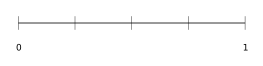
If a number line from \(0\) to \(1\) is split into \(3\) equal parts, what fraction marks the first partition?
A number line shows \(0\) and \(1\) divided in half (into 2 equal parts). The first tick mark is at which fraction?
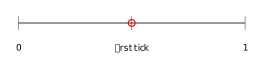
A number line from \(0\) to \(1\) is divided into \(6\) equal parts. What is the distance between \(0\) and the first tick?
A number line from \(0\) to \(1\) is split into \(8\) equal parts. Mark where \(\frac{1}{8}\) is located. Which tick mark shows \(\frac{1}{8}\)?
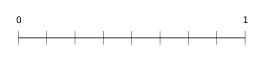
Sam divides a number line from \(0\) to \(1\) into \(4\) equal parts. How many parts are between \(0\) and the second tick mark?
Ava draws two number lines from \(0\) to \(1\). One is split into \(3\) equal parts; the other is split into \(4\) equal parts. Which unit fraction represents a smaller piece?
When the interval from \(0\) to \(1\) is split into \(5\) equal parts, each part has length \(\frac{1}{5}\).
The first tick is at one of four equal parts, which is \(\frac{1}{4}\).
Splitting from \(0\) to \(1\) into three equal parts gives \(\frac{1}{3}\) for each.
Divided in half means 2 equal parts. The first tick is at the unit fraction \(\frac{1}{2}\).
When dividing into 6 equal parts, each part is \(\frac{1}{6}\) of the whole.
The number line has 8 equal parts, so the first tick is at \(\frac{1}{8}\).
The second tick is two of the four equal parts from \(0\).
More parts means smaller pieces. When the same line is split into more parts, each part is smaller. \(\frac{1}{4} < \frac{1}{3}\).
