A number line from \(0\) to \(1\) is divided into \(6\) equal parts. Which point is at \(\frac{4}{6}\)?
- The \(2\)nd tick
- The \(3\)rd tick
- The \(4\)th tick
- The \(6\)th tick


Students will represent a fraction a/b on a number line by counting unit-fraction lengths from zero.
A number line from \(0\) to \(1\) is divided into \(6\) equal parts. Which point is at \(\frac{4}{6}\)?
On a number line, the distance from \(0\) to \(4\) is divided into fourths. Which mark shows \(\frac{3}{4}\) of the distance from \(0\) to \(4\)?
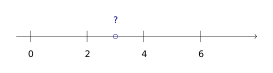
The number line above is divided into equal parts. What fraction of the way from \(0\) to \(4\) is the point marked \(?\)
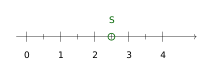
The tick marks divide a number line from \(0\) to \(4\) into halves. Where is point \(S\)?
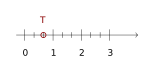
The number line shows tick marks dividing the distance from \(0\) to \(3\) into thirds. Which fraction labels point \(T\)?
Ben marks the location of \(\frac{5}{6}\) on a number line from \(0\) to \(1\) divided into \(6\) equal parts. Which statement is TRUE?
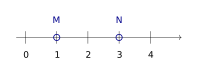
Two points \(M\) and \(N\) are marked on a number line from \(0\) to \(4\). Point \(M\) is at \(1\) and point \(N\) is at \(3\). What fraction of the whole distance from \(0\) to \(4\) is point \(N\)?
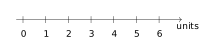
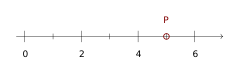
The number line from \(0\) to \(6\) is divided into \(6\) equal parts. Point \(P\) is shown. What fraction of the distance from \(0\) to \(6\) is point \(P\)?
\(\frac{4}{6}\) means count \(4\) copies of unit \(\frac{1}{6}\) starting at \(0\). The 4th tick mark is \(\frac{4}{6}\).
\(\frac{3}{4}\) of the distance from \(0\) to \(4\) means \(\frac{3}{4} \times 4 = 3\). This lands at the \(3\) mark.
The point is at \(3\) on a distance from \(0\) to \(4\). Since \(3\) out of \(4\) equal units are covered, the point is \(\frac{3}{4}\) of the way from \(0\) to \(4\).
Counting from \(0\): each small tick mark is \(\frac{1}{2}\). Point \(S\) is at the 5th tick (at position \(2.5\)), so it is \(5 \times \frac{1}{2} = \frac{5}{2}\).
Point \(T\) is at the second tick of three equal parts from \(0\). That is \(\frac{2}{3}\).
\(\frac{5}{6}\) means \(5 \times \frac{1}{6}\), so there are \(5\) equal steps from \(0\). Distractor A: distance to \(1\) is \(\frac{1}{6}\), which is \(1\) part, not \(1\) tick per se (ambiguous). Distractor C: false; \(\frac{5}{6}\) is much closer to \(1\). Distractor D: false; it is at the 5th tick.
Point \(N\) is at \(3\) on a number line from \(0\) to \(4\). The fraction is \(\frac{3}{4}\).
Point \(P\) is at distance \(5\) on a line from \(0\) to \(6\). Since the total distance is \(6\), the fraction is \(\frac{5}{6}\).
