A bar graph shows the number of books read by students. If each unit on the scale represents \(5\) books, and a bar's height is \(4\) units, how many books does that bar represent?
- \(9\)
- \(15\)
- \(20\)
- \(25\)


Students will create and interpret scaled picture graphs and bar graphs and solve comparison problems.
A bar graph shows the number of books read by students. If each unit on the scale represents \(5\) books, and a bar's height is \(4\) units, how many books does that bar represent?
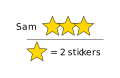
A picture graph shows stickers collected. Each star represents \(2\) stickers. If Sam has \(3\) stars, how many stickers does Sam have?
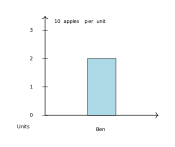
Look at the bar graph. Each mark represents \(10\) apples. How many apples does Ben have?
A picture graph shows pencils. Each pencil symbol means \(5\) pencils. Maya has \(4\) symbols. How many pencils does Maya have?
A picture graph shows marbles. Each circle represents \(2\) marbles. Ava has \(5\) circles and Noah has \(3\) circles. How many more marbles does Ava have?
A bar graph shows cookies sold. The scale is \(5\) cookies per unit. Lily's bar reaches \(3\) units. How many cookies did Lily sell?
A bar graph shows books checked out from the library. One bar is \(4\) units tall, the other is \(2\) units tall. Each unit represents \(5\) books. How many more books does the first bar show?
A bar graph shows toy cars. The scale shows \(10\) cars per unit. Eli's bar is \(2\) units tall. How many cars does Eli have?
Multiply the number of units by the scale: \(4\times5=20\) books.
Count the stars and multiply by the scale: \(3\times2=6\) stickers.
Ben's bar is 2 units tall. \(2\times10=20\) apples.
Multiply: \(4\times5=20\) pencils.
Ava: \(5\times2=10\). Noah: \(3\times2=6\). Difference: \(10-6=4\).
Multiply: \(3\times5=15\) cookies.
First bar: \(4\times5=20\). Second bar: \(2\times5=10\). Difference: \(20-10=10\).
\(2\times10=20\) cars.
