Which fraction equals the whole number \(3\)?
- \(\frac{1}{3}\)
- \(\frac{3}{1}\)
- \(\frac{1}{1}\)
- \(\frac{3}{3}\)


Students will express whole numbers as fractions and recognize fractions equivalent to whole numbers.
Which fraction equals the whole number \(3\)?
Which fraction is equal to the whole number \(5\)?
What whole number is equal to \(\frac{4}{4}\)?
Which fraction equals the whole number \(2\)?
What whole number is \(\frac{6}{6}\)?
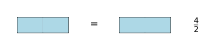
Look at the bar diagram. It shows \(\frac{4}{2}\). What whole number does this equal?
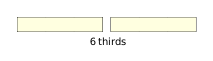
What whole number equals \(\frac{6}{3}\)? Use the bar diagram to help.
Which fraction equals \(1\) whole?
Any whole number can be written as that number over \(1\). So \(3 = \frac{3}{1}\). (D) equals \(1\), not \(3\).
Any whole number with denominator \(1\) equals that number. \(5 = \frac{5}{1}\). Check: (B) is all fifths, (C) is a unit fraction, (D) is not whole.
When numerator \(=\) denominator, you have all the parts of one whole. \(\frac{4}{4}\) has \(4\) fourths, which makes \(1\) whole.
\(2\) equals \(\frac{2}{1}\) (two wholes divided into one part each).
A fraction where numerator \(=\) denominator always equals \(1\). \(\frac{6}{6} = 1\).
The bar shows \(4\) halves. \(4\) halves make \(2\) whole units. \(\frac{4}{2} = 2\).
\(6\) thirds equals \(2\) wholes. Each whole has \(3\) thirds, so \(6 \div 3 = 2\) wholes.
When numerator \(=\) denominator, the fraction equals \(1\) whole. \(\frac{3}{3} = 1\).
