An angle is split into two smaller angles. One measures 30° and the other measures 45°. What is the measure of the whole angle?
- 15°
- 65°
- 75°
- 90°


Students will decompose angles and use addition or subtraction equations to find unknown angle measures.
An angle is split into two smaller angles. One measures 30° and the other measures 45°. What is the measure of the whole angle?
Two rays form an angle with a measure of 80°. If one part of the angle is 32°, what is the measure of the other part?
A straight angle measures 180°. If it is split into two angles, and one angle is 125°, what is the measure of the other angle?
An angle measures 120° and is divided into three equal parts. What is the measure of each part?
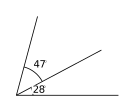
Look at the angle diagram. Two angles share a vertex. One angle measures 28° and the other measures 47°. Together, what is the total measure of both angles?
A right angle measures 90°. If it is divided into two angles measuring 35° and another angle, what is the measure of the unknown angle?
A pie is cut into slices. One slice represents an angle of 40° and another slice represents an angle of 60°. If these two slices are placed together, what angle do they form?
Two smaller angles are combined to form a larger angle. The smaller angles measure 22° and 58°. What is the measure of the larger angle?
When you split an angle into smaller parts, add them to find the whole: \(30°+45°=\mathbf{75°}\).
To find the missing part, subtract what you know from the total: \(80° - 32° = \mathbf{48°}\).
Since a straight angle measures 180°, subtract the known part: \(180° - 125° = \mathbf{55°}\).
Split the angle equally among all parts: \(120° \div 3 = \mathbf{40°}\).
The diagram shows two angles meeting at one vertex. Add them together: \(28° + 47° = \mathbf{75°}\).
A right angle is 90°. Subtract the known part: \(90° - 35° = \mathbf{55°}\).
When pie slices are combined, their angles add up: \(40° + 60° = \mathbf{100°}\).
When smaller angles combine, they add to form the larger angle: \(22° + 58° = \mathbf{80°}\).
