A quadrilateral has exactly one pair of parallel sides. What type of figure is it?
- Parallelogram
- Trapezoid
- Rectangle
- Rhombus


Students will classify two-dimensional figures using parallel lines, perpendicular lines, and angle attributes.
A quadrilateral has exactly one pair of parallel sides. What type of figure is it?
Which quadrilateral has four equal sides and four right angles?
A quadrilateral has two pairs of parallel sides and four right angles, but the sides are not all equal. What is it?
A triangle has one right angle. What type of triangle is it?
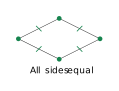
Look at the shape shown. It is a quadrilateral with four equal sides but no right angles. What is it?
Which statement is true about a parallelogram?
A triangle has three angles that are all less than 90 degrees. What type of triangle is it?
A triangle has one angle that is greater than 90 degrees. What is this triangle called?
A trapezoid is defined by having exactly one pair of parallel sides. Since parallelograms, rectangles, and rhombuses each have two pairs of parallel sides, they cannot be trapezoids. The answer is \(\mathbf{B}\).
A square combines two key properties: four equal sides (like a rhombus) and four right angles (like a rectangle). This makes a square a special quadrilateral. The answer is \(\mathbf{C}\).
A rectangle has two pairs of parallel sides and all four right angles. Although opposite sides are equal in length, not all four sides must be equal. The answer is \(\mathbf{B}\).
A right triangle is identified by its one right angle, which measures exactly 90 degrees. The other two angles must be acute. The answer is \(\mathbf{C}\).
A rhombus has four equal sides and two pairs of parallel sides, but does not require right angles. The figure shows equal sides marked on all four sides with no right angles, which defines a rhombus. The answer is \(\mathbf{C}\).
A parallelogram has two pairs of opposite sides that are parallel to each other. This is the defining characteristic that distinguishes a parallelogram from trapezoids and other quadrilaterals. The answer is \(\mathbf{B}\).
An acute triangle is identified by all three angles being less than 90 degrees. When all angles are acute, the triangle itself is classified as acute. The answer is \(\mathbf{B}\).
An obtuse triangle has exactly one angle greater than 90 degrees, called an obtuse angle. The other two angles must be acute. The answer is \(\mathbf{C}\).
