Which fraction is equivalent to \(\frac{2}{3}\)?
- \(\frac{3}{4}\)
- \(\frac{3}{2}\)
- \(\frac{6}{8}\)
- \(\frac{4}{6}\)


Students will generate and recognize equivalent fractions using visual models and multiplicative reasoning.
Which fraction is equivalent to \(\frac{2}{3}\)?
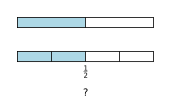
Look at the two fraction bars. Both bars are the same length. Which fraction should replace the question mark?
What fraction is equivalent to \(\frac{1}{2}\)?
Which fraction is in simplest form and equivalent to \(\frac{6}{8}\)?
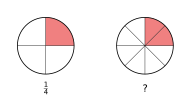
Look at the two circle models. They are the same size. Which fraction should replace the question mark?
Multiply the numerator and denominator of \(\frac{3}{5}\) by 2. What fraction do you get?
Which of these is NOT equivalent to \(\frac{1}{3}\)?
Which fraction equals \(\frac{3}{4}\)?
To find an equivalent fraction, multiply both the numerator and denominator by the same number. Here, multiply by 2: \(\frac{2}{3}=\frac{2\times2}{3\times2}=\frac{4}{6}\). Both pieces are twice as many, but they"re the same size!
The shaded parts in both bars cover the same length, even though the second bar has more pieces. When you divide each half into 2 more pieces, \(\frac{1}{2}\) becomes \(\frac{2}{4}\)—same amount, more pieces.
Multiply both top and bottom by 3: \(\frac{1}{2} = \frac{1\times3}{2\times3} = \frac{3}{6}\). This gives you more pieces, but they still cover the same amount!
To simplify, divide both top and bottom by the same number. Here, divide by 2: \(\frac{6}{8} = \frac{6\div2}{8\div2} = \frac{3}{4}\). This gives you fewer, bigger pieces.
The shaded wedges in both circles are the same size. The first circle is split into 4 pieces (1 shaded), the second into 8 pieces (2 shaded). They cover the same amount: \(\frac{1}{4} = \frac{2}{8}\).
Multiply the numerator and denominator by 2: \(\frac{3}{5} = \frac{3\times2}{5\times2} = \frac{6}{10}\).
Check each option: \(\frac{1}{3} = \frac{2}{6} = \frac{3}{9} = \frac{4}{12}\). All equivalent! But \(\frac{2}{5}\) is different because when you cross-multiply, \(2 \times 3 = 6\) but \(5 \times 1 = 5\).
Multiply both the numerator and denominator by 2: \(\frac{3}{4} = \frac{3\times2}{4\times2} = \frac{6}{8}\).
