Which expression shows \(\frac{3}{5}\) as a sum of unit fractions?
- \(\frac{1}{5}+\frac{1}{5}\)
- \(\frac{1}{5}+\frac{1}{5}+\frac{1}{5}\)
- \(\frac{3}{5}+\frac{3}{5}+\frac{3}{5}\)
- \(\frac{3}{5}\)


Students will decompose a fraction into a sum of unit fractions and represent the decomposition with equations and models.
Which expression shows \(\frac{3}{5}\) as a sum of unit fractions?
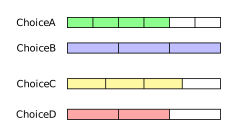
Which fraction bar shows \(\frac{4}{6}\) as a sum of unit fractions?
What is \(\frac{2}{3}\) as a sum of unit fractions?
Sam has a strip of paper divided into 8 equal parts. He colors 5 parts. Which expression shows the fraction colored as a sum of unit fractions?
Which number sentence is correct?
Ming shares a pizza cut into 12 equal slices. He eats 3 slices. Show how many slices he ate as a sum of unit fractions.
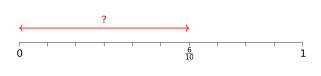
A number line shows equal hops from 0 to \(\frac{6}{10}\). How many hops of \(\frac{1}{10}\) are needed?
How many unit fractions of \(\frac{1}{7}\) make \(\frac{5}{7}\)?
A unit fraction always has a numerator of \(1\). So \(\frac{3}{5}\) breaks down into three copies of \(\frac{1}{5}\): \(\mathbf{\frac{3}{5}=\frac{1}{5}+\frac{1}{5}+\frac{1}{5}}\).
In the fraction bar, we have 4 shaded parts out of 6 equal parts. Each piece is a unit fraction \(\frac{1}{6}\). So we have \(\mathbf{\frac{4}{6}=\underbrace{\frac{1}{6}+\frac{1}{6}+\frac{1}{6}+\frac{1}{6}}_{4 \text{ copies}}}\).
\(\frac{2}{3}\) means two pieces, each of size \(\frac{1}{3}\). So \(\mathbf{\frac{2}{3}=\frac{1}{3}+\frac{1}{3}}\)—two unit fractions added together.
Sam colored 5 pieces out of 8 equal parts, so the fraction is \(\frac{5}{8}\). This is the sum of five unit fractions: \(\mathbf{\frac{5}{8}=\underbrace{\frac{1}{8}+\frac{1}{8}+\frac{1}{8}+\frac{1}{8}+\frac{1}{8}}_{5 \text{ copies}}}\).
When we add unit fractions with the same denominator, we keep the denominator and add the numerators. \(\frac{1}{4}+\frac{1}{4}+\frac{1}{4}\) has three 1's in the numerator, so it equals \(\mathbf{\frac{3}{4}}\). The other choices incorrectly change the denominator.
Ming ate 3 slices out of 12 equal slices, so the fraction is \(\frac{3}{12}\). Breaking this into unit fractions: \(\mathbf{\frac{3}{12}=\frac{1}{12}+\frac{1}{12}+\frac{1}{12}}\)—three slices, each representing \(\frac{1}{12}\) of the pizza.
To reach \(\frac{6}{10}\) with hops of \(\frac{1}{10}\), we count: each hop is one unit fraction, and we need 6 copies to equal \(\frac{6}{10}\). So \(\mathbf{6 \text{ hops}}\) gets us there!
\(\frac{5}{7}\) means we have 5 equal pieces, and each piece is \(\frac{1}{7}\). So \(\mathbf{5}\) unit fractions of \(\frac{1}{7}\) make up \(\frac{5}{7}\).
