How many copies of \(\frac{1}{6}\) are in \(\frac{5}{6}\)?
- \(1\)
- \(5\)
- \(6\)
- \(\frac{1}{5}\)


Students will interpret a fraction as a multiple of a unit fraction and connect that interpretation to multiplication.
How many copies of \(\frac{1}{6}\) are in \(\frac{5}{6}\)?
Write \(\frac{3}{4}\) as a multiplication of a whole number and a unit fraction.
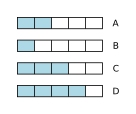
Which picture shows \(\frac{2}{5}\) as two unit fractions of \(\frac{1}{5}\)?
How many \(\frac{1}{8}\)'s are in \(\frac{7}{8}\)?
Which multiplication sentence matches \(\frac{4}{10}\)?
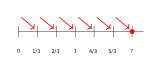
A number line shows jumps of \(\frac{1}{3}\) starting at \(0\). If you make \(6\) jumps, where do you land?
Which of the following is the same as \(5 \times \frac{1}{12}\)?
A fraction bar is divided into \(6\) equal parts with \(4\) parts shaded. Express this as a multiplication of a unit fraction.
The fraction \(\frac{5}{6}\) means \(5\) copies of the unit fraction \(\frac{1}{6}\), so \(\frac{5}{6}=5\times\frac{1}{6}\). The answer is \(\mathbf{5}\) copies.
The numerator \(3\) tells us how many unit fractions we have, and the denominator \(4\) tells us the unit fraction is \(\frac{1}{4}\). So \(\frac{3}{4}\) equals \(3 \times \frac{1}{4}\).
Count the shaded parts: there are \(2\) shaded parts. Count the equal parts: there are \(5\) total parts. So the fraction bar shows \(2\) copies of \(\frac{1}{5}\), which is \(\frac{2}{5}\).
The fraction \(\frac{7}{8}\) is equal to \(7\) copies of the unit fraction \(\frac{1}{8}\), so we have \(7 \times \frac{1}{8} = \frac{7}{8}\). There are \(\mathbf{7}\) unit fractions.
The fraction \(\frac{4}{10}\) is the same as \(4\) copies of \(\frac{1}{10}\). We write this multiplication as \(4 \times \frac{1}{10}\).
Each jump is \(\frac{1}{3}\). Making \(6\) jumps is the same as \(6 \times \frac{1}{3} = \frac{6}{3}\). Since \(3\) thirds make one whole, \(\frac{6}{3}\) equals \(\mathbf{2}\) wholes.
When we multiply a whole number by a unit fraction, we get that many copies of the unit fraction. So \(5 \times \frac{1}{12}\) means \(5\) copies of \(\frac{1}{12}\), which is \(\frac{5}{12}\).
Count the shaded parts: \(4\) parts. Count the equal parts: \(6\) total. So this shows \(4\) copies of \(\frac{1}{6}\), which we write as \(4 \times \frac{1}{6}\).
