Which tool is used to measure the size of an angle in degrees?
- Protractor
- Compass
- Ruler
- Calculator


Students will measure and draw angles with a protractor and identify common protractor-reading errors.
Which tool is used to measure the size of an angle in degrees?
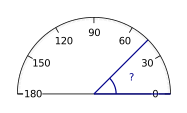
What is the measure of the angle shown in blue?
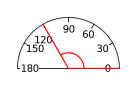
A student measures an angle with a protractor. The angle opens to the 120-degree mark. What type of angle is this?
How many degrees does a right angle measure?
When using a protractor, you have two scale choices (inner and outer). If the angle is opened towards the right side of the protractor, which scale should you use?
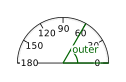
What is the measure of the angle shown?
Sam uses a protractor to measure an angle. The angle lines up exactly with the 90-degree mark. What type of angle is this?
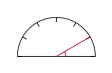
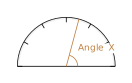
What is the best estimate of the angle shown as Angle X?
A protractor is the special tool we use to measure angles in whole-number degrees. The ruler measures length and the compass draws circles, but only the protractor shows us how many degrees are in an angle.
The baseline of the angle starts at 0° on the right. Follow the second ray until it crosses the degree scale—it lines up perfectly with the 45-degree mark. The answer is \(\mathbf{45}\) degrees.
An obtuse angle opens wider than a right angle (more than 90°) but is not a straight line (less than 180°). Since 120° fits perfectly between these benchmarks, the answer is \(\mathbf{\text{obtuse}}\).
A right angle is a special angle that measures exactly 90° every time—no more, no less. You see right angles at the corners of books, windows, doors, and many shapes we use every day. The answer is \(\mathbf{90}\) degrees.
The key to reading a protractor is to use the scale that starts at 0° on the same side where your angle opens. When an angle opens toward the right, that side shows 0°—read the outer scale. This matches where the angle is heading. The answer is \(\mathbf{\text{use the outer scale}}\).
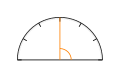
One ray sits on the baseline at 0°, and the other ray points to the 30° mark. Since \(30° < 90°\), this is an acute angle. The answer is \(\mathbf{30}\) degrees.
Whenever an angle measures exactly 90°, we call it a right angle. It's one of the most important angles we measure because it appears everywhere—in book corners, window frames, and the letter L. This angle aligns perfectly with 90°, so the answer is \(\mathbf{\text{right angle}}\).
The ray falls between the 60° benchmark and the 90° benchmark. It's closer to the midpoint between them, which is around 75°. The answer is \(\mathbf{75}\) degrees.
