Which shows a multiple of \(\frac{2}{3}\)?
- \(\frac{2}{6}\)
- \(\frac{4}{9}\)
- \(\frac{4}{3}\)
- \(\frac{5}{6}\)


Students will generate multiples of a fraction and represent them with equations, number lines, and models.
Which shows a multiple of \(\frac{2}{3}\)?
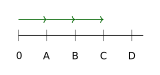
Sam has a number line with hops of \(\frac{1}{4}\). Which point represents \(3\times\frac{1}{4}\)?
Which fraction is a multiple of \(\frac{1}{5}\)?
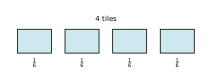
Maya lined up 4 unit-fraction tiles. If each tile is \(\frac{1}{6}\), what is the total?
Which shows the first four consecutive multiples of \(\frac{1}{3}\) in order?
What is \(5 \times \frac{1}{4}\)?
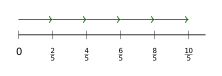
A number line shows hops of \(\frac{2}{5}\). How many hops to reach \(\frac{10}{5}\)?
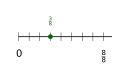
Noah skipped by \(\frac{1}{8}\) along a number line. He stopped at \(\frac{3}{8}\). How many skips did he make?
The multiples of \(\frac{2}{3}\) are: \(\frac{2}{3}, \frac{4}{3}, \frac{6}{3}, \ldots\) Each one is obtained by multiplying \(\frac{2}{3}\) by whole numbers. Since \(\frac{4}{3} = 2 \times \frac{2}{3}\), the answer is \(\mathbf{\frac{4}{3}}\).
Starting at 0, each hop moves us forward by \(\frac{1}{4}\). After three hops, we land at \(3 \times \frac{1}{4} = \frac{3}{4}\), which is Point C.
A multiple of \(\frac{1}{5}\) means we count by fifths. We can write \(\frac{2}{5} = 2 \times \frac{1}{5}\), so it"s a multiple. The others don"t fit that pattern.
Four tiles, each \(\frac{1}{6}\), combine to make \(4 \times \frac{1}{6} = \frac{4}{6}\).
Multiples of \(\frac{1}{3}\) count by thirds: first \(\frac{1}{3}\), then \(\frac{2}{3}\), then \(\frac{3}{3}\), then \(\frac{4}{3}\). The fraction \(\frac{3}{3}\) equals \(1\), but it is written in thirds here to show the counting pattern. That"s exactly what choice B shows!
When we multiply by the numerator, we keep the denominator the same. So \(5 \times \frac{1}{4} = \frac{5}{4}\).
Each hop is \(\frac{2}{5}\). To reach \(\frac{10}{5}\), we need \(5 \times \frac{2}{5} = \frac{10}{5}\), so it takes 5 hops.
Noah skips in eighths: \(\frac{1}{8}, \frac{2}{8}, \frac{3}{8}\). After 3 skips, he"s at \(\frac{3}{8}\).
