Jada has \(3\) stickers. Her brother has \(5\) times as many stickers. How many stickers does her brother have?
- \(8\)
- \(35\)
- \(18\)
- \(15\)


Students will solve multiplicative-comparison word problems using equations, diagrams, and clear reasoning.
Jada has \(3\) stickers. Her brother has \(5\) times as many stickers. How many stickers does her brother have?
Sam has \(4\) trading cards. Maya has \(6\) times as many trading cards as Sam. How many trading cards does Maya have?
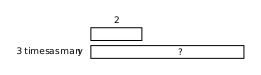
Elena has \(2\) books. Her friend has \(3\) times as many books. How many books does her friend have?
Noah has \(7\) crayons. His sister has \(2\) times as many crayons as Noah. How many crayons does his sister have?
Aisha has \(5\) pet fish. Kai has \(4\) times as many fish as Aisha. How many fish does Kai have?
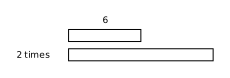
Miguel has \(6\) toy cars. Diego has \(2\) times as many toy cars. How many cars does Diego have?
Lily had \(3\) sticker sheets. Her grandmother gave her \(4\) times as many sticker sheets as Lily already had. How many sticker sheets does Lily have in all?
Zoe's basketball team scored \(9\) points in the first quarter. In the second quarter, they scored \(2\) times as many points. How many points did they score in the second quarter?
"\(5\) times as many" is a multiplication signal. Her brother has \(5\) groups of Jada's \(3\) stickers: \(5 \times 3 = 15\) stickers.
"\(6\) times as many" tells us to multiply. Maya has \(6\) groups of Sam's \(4\) cards: \(6 \times 4 = 24\) trading cards.
The bar model shows the friend's bar split into \(3\) equal pieces, each the size of Elena's \(2\) books. So we multiply: \(3 \times 2 = 6\) books.
"\(2\) times as many" is a multiplication clue. Noah's sister has \(2\) groups of \(7\) crayons: \(2 \times 7 = 14\) crayons.
"\(4\) times as many" is a multiplication signal. Kai has \(4\) groups of Aisha's \(5\) fish: \(4 \times 5 = 20\) fish.
The bar model shows Diego's bar is twice as long as Miguel's---\(2\) groups of \(6\). So multiply: \(2 \times 6 = 12\) cars.
Two steps! Step 1: Grandma gave Lily \(4 \times 3 = 12\) more sheets. Step 2: Add what Lily already had: \(3 + 12 = 15\) sheets in all.
"\(2\) times as many" means multiply. The team scored \(2 \times 9 = 18\) points in the second quarter.
