Which equation shows that \(24\) is \(6\) times as many as \(4\)?
- \(24+4=28\)
- \(24-4=20\)
- \(24=6\times4\)
- \(24\div4=9\)


Students will interpret multiplication equations as multiplicative comparisons and explain the relationship between two quantities.
Which equation shows that \(24\) is \(6\) times as many as \(4\)?
Maria has \(3\) stickers. Sam has \(2\) times as many stickers as Maria. How many stickers does Sam have?
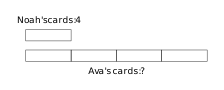
Look at the bar model below. Which equation matches? Noah has \(4\) cards. Ava has \(4\) times as many cards as Noah. Which equation shows the number of cards Ava has?
There are \(5\) green marbles. There are \(3\) times as many red marbles as green marbles. Which equation shows how many red marbles there are?
Which statement matches the equation \(12 = 3 \times 4\)?
Leo reads \(2\) books. His sister reads \(5\) times as many books as Leo. How many books does his sister read?
Diego has \(6\) toy cars. Chen has \(4\) times as many toy cars as Diego. How many more cars does Chen have than Diego?
Mia bakes \(8\) cookies. Max bakes \(2\) times as many cookies as Mia. How many cookies does Max bake?
When you see "times as many," think multiplication! "\(6\) times as many as \(4\)" becomes \(6 \times 4\), which equals \(24\). So choice C, \(24 = 6 \times 4\), is the equation that captures that idea.
"\(2\) times as many" is your signal to multiply. Sam has \(2\) groups of Maria's \(3\) stickers: \(2 \times 3 = 6\). So Sam has \(\mathbf{6}\) stickers.
Look at the picture: Ava's bar is split into \(4\) equal pieces, each the same length as Noah's bar. That's exactly what "\(4\) times as many" means---so we multiply: Ava \(= 4 \times 4 = 16\) cards.
"\(3\) times as many" is a multiplication clue. Make \(3\) groups of the \(5\) green marbles: \(5 \times 3 = 15\) red marbles. Choice C is the equation that shows this.
Read \(12 = 3 \times 4\) in words: "\(12\) equals \(3\) groups of \(4\)." That's the same as saying "\(12\) is \(3\) times as many as \(4\)." The other choices use more, plus, or less---those describe adding or subtracting, not multiplying.
"\(5\) times as many" means we multiply. Leo's sister reads \(5\) groups of \(2\) books, so \(5 \times 2 = 10\) books.
This is a two-step problem. Step 1: find Chen's cars: \(4 \times 6 = 24\). Step 2: "how many more" is a subtraction question, so \(24 - 6 = 18\). Chen has \(\mathbf{18}\) more cars than Diego.
"\(2\) times as many" is a multiplication signal. Max bakes \(2\) groups of Mia's \(8\) cookies: \(8 \times 2 = 16\) cookies.
