What is \(4\times\frac{2}{5}\)?
- \(\frac{4}{5}\)
- \(\frac{6}{5}\)
- \(\frac{8}{20}\)
- \(\frac{8}{5}\)


Students will multiply a fraction by a whole number using repeated addition, visual models, and equations.
What is \(4\times\frac{2}{5}\)?
What is \(3\times\frac{1}{4}\)?
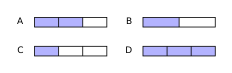
Which picture shows \(2\times\frac{1}{3}\)?
What is \(5\times\frac{1}{6}\)?
Sam has 3 cookies. Each cookie is \(\frac{2}{3}\) of a cup of flour. How much flour is in all of Sam's cookies?
What is \(2\times\frac{3}{4}\)?
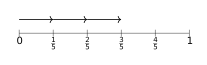
Use the number line to find \(3\times\frac{1}{5}\).
What is \(6\times\frac{1}{8}\)?
We have 4 copies of \(\frac{2}{5}\). Multiply the whole number by the numerator: \(4\times\frac{2}{5}=\frac{4\times2}{5}=\frac{8}{5}\). The answer is \(\mathbf{\frac{8}{5}}\).
We take 3 copies of \(\frac{1}{4}\). Multiply the whole number by the numerator: \(3\times\frac{1}{4}=\frac{3\times1}{4}=\frac{3}{4}\). The answer is \(\mathbf{\frac{3}{4}}\).
When we multiply \(2\times\frac{1}{3}\), we're taking 2 copies of \(\frac{1}{3}\), which gives us \(\frac{2}{3}\). Picture A shows one whole divided into thirds with exactly 2 parts shaded. This is \(\mathbf{\text{Picture A}}\).
We take 5 copies of \(\frac{1}{6}\) and add them together. Multiply the whole number by the numerator: \(5\times\frac{1}{6}=\frac{5\times1}{6}=\frac{5}{6}\). The answer is \(\mathbf{\frac{5}{6}}\).
Sam has 3 cookies, each using \(\frac{2}{3}\) cup of flour. Multiply: \(3\times\frac{2}{3}=\frac{3\times2}{3}=\frac{6}{3}=2\) cups. The answer is \(\mathbf{2 \text{ cups}}\).
We take 2 copies of \(\frac{3}{4}\). Multiply: \(2\times\frac{3}{4}=\frac{2\times3}{4}=\frac{6}{4}=1\frac{2}{4}=1\frac{1}{2}\). The answer is \(\mathbf{1\frac{1}{2}}\).
On the number line, we make 3 jumps of \(\frac{1}{5}\) each. Starting at 0: hop to \(\frac{1}{5}\), then \(\frac{2}{5}\), then \(\frac{3}{5}\). This shows \(3\times\frac{1}{5}=\frac{3}{5}\). The answer is \(\mathbf{\frac{3}{5}}\).
We take 6 copies of \(\frac{1}{8}\). Multiply: \(6\times\frac{1}{8}=\frac{6\times1}{8}=\frac{6}{8}=\frac{3}{4}\). The answer is \(\mathbf{\frac{3}{4}}\).
