A pattern starts at \(3\) and follows the rule "add \(4\)." What is the \(5\)th term in the pattern?
- \(15\)
- \(16\)
- \(19\)
- \(23\)


Students will generate, extend, and explain number and shape patterns using observable rules.
A pattern starts at \(3\) and follows the rule "add \(4\)." What is the \(5\)th term in the pattern?
Which number comes next in the pattern? \(2, 6, 10, 14, 18, \underline{\quad}\)
A pattern starts at \(50\) and follows the rule "subtract \(5\)." Which list shows the first four terms?
Looking at this pattern, what is the rule?
\(8, 16, 24, 32, 40, \ldots\)
A pattern follows the rule "add \(3\)." If the second term is \(10\), what is the first term?
Look at the table below. What is the rule for the pattern?
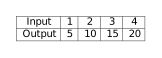
Which of the following shows a pattern where all numbers are even?
Which pattern shows all multiples of \(4\)?
Start at \(3\) and apply "add \(4\)" four more times: \(3, 7, 11, 15, \mathbf{19}\). The 5th term is \(\mathbf{19}\).
First find the rule by looking at the gaps: \(6-2=4\), \(10-6=4\), \(14-10=4\), \(18-14=4\). So the rule is "add \(4\)." Apply it once more: \(18 + 4 = \mathbf{22}\).
Apply "subtract \(5\)" starting at \(50\). Term 1: \(50\). Term 2: \(50 - 5 = 45\). Term 3: \(45 - 5 = 40\). Term 4: \(40 - 5 = 35\). So the first four terms are \(50, 45, 40, 35\), which matches choice A.
Find the difference: \(16 - 8 = 8\), \(24 - 16 = 8\), \(32 - 24 = 8\). Each term increases by \(8\). \checkmark
Work backwards: if "add \(3\)" gives \(10\), then the first term is \(10 - 3 = \mathbf{7}\).
Check the rule: \(1 \times 5 = 5\), \(2 \times 5 = 10\), \(3 \times 5 = 15\), \(4 \times 5 = 20\). The rule is "multiply by \(5\)". \checkmark
Remember: even numbers end in \(0\), \(2\), \(4\), \(6\), or \(8\). Check each list: choice A has \(5\) and \(11\) (odd), choice C has \(3\), \(9\), \(15\) (odd), choice D has \(1\), \(3\), \(5\) (odd). Only choice B---\(4, 8, 12, 16, 20\)---has every term ending in an even digit, so every term is even. \checkmark
Multiples of \(4\) are: \(4, 8, 12, 16, 20, \ldots\) Check choice C: \(4 \div 4 = 1\), \(8 \div 4 = 2\), \(12 \div 4 = 3\). All divide evenly. \checkmark
