In the number \(6{,}663\), the value of the digit \(6\) in the hundreds place is how many times the value of the digit \(6\) in the tens place?
- \(1\)
- \(1{,}000\)
- \(100\)
- \(10\)


Students will explain how the value of a digit changes by a factor of ten as its place changes.
In the number \(6{,}663\), the value of the digit \(6\) in the hundreds place is how many times the value of the digit \(6\) in the tens place?
What is the value of the digit \(5\) in the number \(5{,}204\)?
Look at the place-value chart below. What is the value of the digit in the tens place?

In the number \(4{,}449\), which digit appears in both the thousands and hundreds places?
In the number \(7{,}777\), the digit \(7\) in the thousands place is how many times the value of the digit \(7\) in the ones place?
Maya built a model of the number \(2{,}345\) using base-ten blocks. How many thousands blocks did she use?
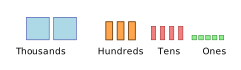
What is the value of the digit \(8\) in the number \(1{,}289\)?
In the number \(5{,}059\), how many times greater is the value of the digit \(5\) in the thousands place than the digit \(5\) in the ones place?
The \(6\) in the hundreds place is worth \(600\), and the \(6\) in the tens place is worth \(60\). Since \(600 \div 60 = 10\), the hundreds place is \(10\) times greater. \(\checkmark\)
The digit \(5\) is in the thousands place. Its value is \(5 \times 1{,}000 = \mathbf{5{,}000}\). \(\checkmark\)
Looking at the chart, the digit in the tens place is \(7\). Its value is \(7 \times 10 = \mathbf{70}\). \(\checkmark\)
Look at each place in \(4{,}449\) from left to right: thousands \(= 4\), hundreds \(= 4\), tens \(= 4\), ones \(= 9\). The digit \(\mathbf{4}\) appears in the thousands place (worth \(4{,}000\)) and the hundreds place (worth \(400\)). Notice: same digit, but its value depends on its place---\(4{,}000\) is \(10 \times 400\). \checkmark
The \(7\) in the thousands place is worth \(7{,}000\). The \(7\) in the ones place is worth \(7\). Since \(7{,}000 \div 7 = 1{,}000\), the answer is \(\mathbf{1{,}000}\) times. \(\checkmark\)
In \(2{,}345\), the thousands digit is \(2\). Each thousands block represents \(1{,}000\), so Maya used \(\mathbf{2}\) thousands blocks. \(\checkmark\)
In \(1{,}289\), the digit \(8\) is in the tens place. Its value is \(8 \times 10 = \mathbf{80}\). \(\checkmark\)
The \(5\) in the thousands place is worth \(5{,}000\). The \(5\) in the ones place is worth \(5\). So \(5{,}000 \div 5 = \mathbf{1{,}000}\) times. \(\checkmark\)
